A Subject-Centric Architecture for Identity, Trust, Delegation and Discovery of Agentic AI
Contribution number FG-TIDA-WG2-002
Versions:
| Document | Author(s) | Jaedoo Kim |
|---|---|---|
| Submitted by | Jaedoo Kim | |
| Affiliation(s) | PAX S&T Co., Ltd., Republic of Korea | |
| Submission contact | jdookim0307@gmail.com | |
| Version | 0.1 · recorded | |
| Last updated | 2026-11-25 19:14 UTC | |
| Formats | ZIP Text | |
| FG-TIDA workflow | State | Submitted |
| Working group / stream | WG2: Identity, Behaviour and Enforcement for AI Agents (IBEA) | |
| History | Decisions and changes · latest activity 2026-11-25 19:14 UTC | |
| Secretariat | tsbfgtida@itu.int |
Repository creation follows working-group adoption.
Archived versions
This reading preview includes the RST chapters and their referenced images. Download the source ZIP for the complete folder structure and supporting files. Submitted build configuration and diagram source files are not executed in this preview.
Abstract
This contribution proposes that identity, trust, authority and accountability in agentic AI ecosystems be anchored to the persistent Subject, the human, organization or institution on whose behalf an agent acts, rather than to the agent itself. Agents are treated as delegated, replaceable functions: they may carry identifiers of any scope, but they need not become independent roots of authority. Cross-domain interoperability then depends on common semantics for Subject anchoring, bounded delegation, current validity and attribution. The contribution defines the terms it uses, compares the model with existing approaches (OAuth 2.0 and token exchange, OpenID Connect, W3C DIDs and Verifiable Credentials, A2A, MCP authorization, SPIFFE and telecom subscriber identification) to identify where a common profile may be missing, states minimum security properties for a delegation artefact, proposes four architectural properties for assessment (Subject control, provider independence, jurisdictional federation and no single point of control), and describes four use cases, including a cross-border one. It makes seven proposals mapped to the FG-TIDA objectives and deliverables.
History
Version |
Document |
Approval |
Focus Group |
Working Group |
|---|---|---|---|---|
Input 1.0 |
A Subject-Centric Architecture for Identity, Trust, Delegation and Discovery of Agentic AI |
Not applicable (input contribution) |
TIDA |
WG2 (IBEA) |
Template adaptation (original history retained):
Version: 0.1
Document: A Subject-Centric Architecture for Identity, Trust, Delegation and Discovery of Agentic AI
Approval: Not recorded. Template adaptation is not approval.
Focus Group: TIDA
Working Group / stream: WG2: Identity, Behaviour and Enforcement for AI Agents (IBEA)
Authors
Name |
Affiliation |
Contact |
|---|---|---|
Jaedoo Kim |
PAX S&T Co., Ltd., Republic of Korea |
Keywords
agentic AI; Subject; principal; delegation artefact; identity; trust; discovery; accountability; existing identity systems; cross-border trust; provider independence
Foreword
This contribution is submitted to the ITU-T Focus Group on Trust and Identity for Humans and Agentic AI (FG-TIDA). Publication in the tracker records a submission and does not imply endorsement or approval by the Focus Group. This paragraph provides tracker context; the technical content below is retained from the source.
Input contribution to FG-TIDA — PAX S&T Co., Ltd. (Republic of Korea)
Note
This document is an input contribution to the first FG-TIDA meeting (Paris, 30 November – 1 December 2026), submitted for discussion and proposal. It is addressed to WG2 (Identity, Behaviour and Enforcement for AI Agents); its working definitions (clause 3) and use cases (clause 10) also relate to the scope of WG0 (Use Cases and Terminology). The clause numbering of the original input document is kept, and cross-references in the text (for example "clause 7.2") refer to it.
Original front matter
AI agents now search, compare, negotiate, fill in forms, call services and initiate payments on behalf of people and organizations. Each of these actions raises the same practical questions for the party at the other end: who is this agent acting for, what has it been allowed to do, is that permission still valid, and who answers for the result?
Today these questions are often answered within each service or platform. A user signs in, the platform issues the agent a token or an account, and the counterparty trusts the agent largely to the extent that it trusts the platform. This works within one ecosystem. It becomes harder when agents cross domains and borders, when agents create sub-agents, and when the user wants to change the AI provider without losing the relationships, records and permissions built up over time.
This contribution addresses a prior architectural question: what should be the persistent root of identity, trust, authority, discovery and accountability in an agentic AI ecosystem? This contribution argues that the root should remain the Subject on whose behalf the agent acts, while the agent remains a delegated, replaceable function bound to that Subject. Identifying or discovering agents directly is not in itself the problem; the concern is designs in which an agent becomes an independent root of authority without a verifiable binding to the Subject it represents.
The proposal is derived from the HWW (Hyper-Web World Wide) architecture published by the source as a white paper [HWW-WP]. Only the elements relevant to the FG-TIDA terms of reference are presented here.
The contribution relates to FG-TIDA objectives 3.1 (terminology and definitions), 3.2 ((pre-)standardization roadmap, including standardization gaps), 3.3 (use cases) and 3.4 (assessment criteria), and to expected deliverables 4.1 (use cases and requirements), 4.2 (architectures, including agent discovery and trust establishment), 4.3 (trust lifecycle, revocation and human oversight) and 4.5 (guidelines, assessment criteria and metrics). Within Annex A it responds to the identity stack for agentic AI, which lists delegation and agent discovery among its layers (A.1.1); the properties of a delegation artefact (A.1.2); requirements for payment use cases, where amounts and cumulative limits matter (A.1.3); trust lifecycle and human oversight topics (A.2.2, A.2.4); the trust control plane, to which the treatment of cumulative state and revocation propagation contributes in part (A.2.7); trust interoperability requirements across jurisdictions and sectors, with a gap analysis against existing standards (A.2.5); and the architecture to scale trust management across borders while respecting sovereign implementations, which includes cross-border agent discovery and trust establishment (A.3.2). The mapping is given in Table 3.
The contribution does not propose an agentic AI protocol, and it does not address AI governance or the content of national digital identity systems, all of which are outside the FG-TIDA scope. It proposes requirements and architectural semantics. The FG-TIDA terms of reference already assume that agents must be bound to the humans and organizations they act for; this contribution places that binding at the root of the architecture rather than as an addition to agent identity, and generalizes the human to the Subject (natural person, organization or public body). The model reuses existing national, telecom, enterprise and professional identity systems as trust sources without modifying them. A protocol specification developed by the source for the wider architecture [HCTP-Core] is cited as background only and is not proposed for standardization here.
The following working definitions are offered as input to the FG-TIDA terminology work (objective 3.1). They are not intended to replace existing ITU-T terms [ITU-T X.1252]. The main difference, for "Subject", is stated below; alignment of the other terms with X.1252 is proposed as part of the terminology work.
Term |
Meaning in this contribution |
|---|---|
Subject |
The role of a human, organization, institution or other entity recognized under the applicable domain or governance system as a persistent source of authority and accountability, to which an agent's authority is ultimately attributed. It corresponds to the principal of much delegation literature, but is narrower than "principal" in [ITU-T X.1252], which denotes an entity whose identity can be authenticated and which, as we read it, can include software. It is also distinct from the subject of a DID or of a Verifiable Credential. |
Agent |
A functional resource, typically AI-based, that acts for a Subject under delegated authority. An agent may be long-lived or created for a single task, session or counterparty. |
Delegation |
An explicit, bounded grant of authority from a Subject to an agent, or onward from an agent to a sub-agent where the source grant permits it. A re-delegation can never exceed its source; it may preserve or narrow it. |
Delegation artefact |
A verifiable record that expresses a delegation and its conditions in a form that a relying party in another domain can interpret, and that can be bound to the authenticated delegate and to the request at hand (clause 7.2). |
Trust source |
An existing system that issues evidence about a Subject, a qualification or a relationship, for example an operator's subscriber identification, a business or professional registry, or enterprise identity and access management. A wallet that stores and presents such evidence is not in itself a trust source; the trust comes from the issuer. |
External identifier |
An identifier in social use by which others find or contact a Subject, such as an E.164 telephone number, an e-mail address or a domain name. It may change or be reassigned. |
Internal identifier |
A machine-verifiable identifier that refers to the Subject in a way that is stable relative to external identifiers, such as a W3C Decentralized Identifier (DID). It may itself be rotated through authorized transitions. |
Relationship-scoped identifier |
A temporary or per-relationship identifier presented on top of the internal identifier where a relationship calls for it. Its use alone does not guarantee that relationships cannot be linked (clause 6.2). |
Subject continuity root |
A logical construct that keeps a Subject continuous as its identifiers, devices, credentials, agents and AI providers change: its continuity state, its verifiable bindings to identifiers and evidence, and the authorized transitions between them. Called the Universal Key in [HWW-WP]. It is not itself an identifier or a key. Recovery conditions are pre-registered and are discussed in clause 6.3. |
Current validity |
Whether an identity binding, credential or delegation holds at the moment an action is taken, as distinct from whether it held when it was issued. |
Attribution |
For an action taken under valid authority, the verifiable link from the action, its result and its evidence back through the agent and the delegation (or other basis of authority) to the Subject. |
Subject-first discovery |
A discovery pattern whose results are Subjects, whether the Subject is known in advance or found as a candidate by intent or capability; the agents currently acting for a selected Subject are then found under it. |
Jurisdictional federation |
Interconnection of trust domains operated under different jurisdictions, each keeping its own trust sources and acceptance rules, through common semantics rather than a single global registry. |
4.1 Scale and volatility
A single person, enterprise or public institution may create many agents, some for a single task, counterparty, session or transaction. Agents may spawn sub-agents, be replaced, or change capability and delegated authority continuously. If every agent is treated as an independent root that requires its own global trust establishment, reputation, revocation status and accountability mapping, the global trust and discovery state tends to grow with the most volatile class of entities in the system, and persistent trust becomes attached to entities whose existence may be temporary. Delegations still carry their own status in a Subject-anchored model; the difference is that this state is held locally, per Subject and per relationship, rather than in a global trust and discovery space.
4.2 Accountability returns to the Subject
When an agent proposes a contract or a payment, the counterparty needs to know more than the agent's identifier:
Whom does the agent represent?
Did that Subject actually authorize this agent, for this action, towards this counterparty?
What scope, amount and period apply, and is the authorization valid now?
To whom are the result and the responsibility attributed?
The trust chain therefore returns to the Subject. Agent identifiers remain operationally necessary, but they are not the appropriate universal root of authority or accountability.
4.3 Identity held by the provider
Where the identity, trust record and reputation of an agent are created and held only by the platform or AI provider that runs it, the Subject's relationships and permissions are in practice held there as well. Changing provider can then mean re-establishing identity and trust with every counterparty, and dependence on an AI provider can extend into dependence in identity, data and relationships. This follows from where the root of identity is placed rather than from any provider's intent. Clause 8 states architectural properties that address it.
5.1 Architectural inversion
In the typical case, authority flows from the Subject to the agent through explicit delegation, and results and attribution flow back to the Subject. Where authority instead rests on a basis set by law or applicable rule, for example the statutory duties of a public body, that basis takes the place of the delegation in the chain (clause 7.1). In either case the agent is a delegated functional resource associated with the Subject, not an independent root of authority.
5.2 Separation without disconnection
Subject and agent are distinct roles, normally held by distinct entities, and must remain distinguishable; but their identities are bound: the agent's authority and attribution remain anchored to the Subject through verifiable delegation. The requirement is identity separation with explicit binding.
5.3 Where correspondence happens
Function-centric systems — telephony, the web, platforms — interoperate on top of a common naming and discovery system: a numbering plan, a URL syntax and name resolution, a platform account space. Much current work on agents follows the same order: define agent identifiers, registries and discovery first, and add a binding to the human afterwards. Clause 4 explains why that order does not close for agents: they are delegates acting on authority that is not their own; they are created and retired at a pace at which a Subject's persistent trust and relationships would have to be re-bound to transient agent identifiers again and again — a cost in trust-state management that remains even where a registry itself scales well; and no agent identity system has yet come into general use to be mapped.
The Subject-centric model moves the point of correspondence up one level. Identification, trust, discovery and accountability are established between Subjects; once two Subjects can verify each other, the agents acting under them follow. Agents on the two sides do not need to share an identification, discovery or trust system of their own; what they still need is a protocol to talk once they face each other, and any protocol both sides support serves there — an existing agent protocol or an interoperability profile defined for the purpose — provided it carries an authenticated counterparty, the delegation artefact, the binding of each request to it, and the current-validity checks the delegation requires. What is not re-established per agent is the Subject's identity and trust basis; what is checked for every agent is that it is authenticated, bound to its Subject and currently authorized. The order changes, not the inventory. In this architecture an agent is never a root of trust: its identity, authority and accountability are projections of the Subject's, narrowed by delegation.
It follows that no single global agent identifier system is required. An agent identifier may be global, domain-specific, organizational, session-specific or ephemeral, and each domain may assign it under its own namespace, provided that the identifier can be authenticated when the agent acts and is not ambiguous within the delegation that names it. Existing identifier systems for people, organizations and services are kept and reused as they are; the model does not require their replacement. The common requirement therefore shifts:
from universal agent identity to common semantics for Subject anchoring, delegation, authority, current validity and attribution.
6.1 Existing systems as trust sources
Because correspondence is established at the level of Subjects (clause 5.3), the question is what that level reuses. People and organizations already participate in identity and trust infrastructures that carry legal, organizational and social trust: national identity schemes, operator subscriber identification, enterprise identity and access management, professional and business registries, and domain and e-mail identities. An agent ecosystem should not reconstruct this trust for every agent. These systems act as trust sources that issue evidence about a Subject, a qualification or a relationship, at the assurance level each provides; wallets may hold and present that evidence. The agent inherits only bounded authority from the Subject through delegation. The principle is: keep existing identity systems and trust relationships; make the correspondence between them interoperable.
6.2 Dual-identifier model
The dual-identifier model separates two jobs that one identifier is often made to do today, because two kinds of recognition are involved: people recognize a counterpart by a name or number they already know, and machines verify one by a key. No single identifier does both well, and the two actors that the FG-TIDA terms of reference place side by side — the human and the agent — each need the kind suited to them. External identifiers are the ones people already use to find and contact each other: E.164 numbers, e-mail addresses and domain names. They are familiar and widely reachable, but they change and can be reassigned. Internal identifiers, such as DIDs, are machine-verifiable and remain stable relative to those changes. They follow a common standard form; whether a counterparty can resolve and verify a given one depends on the DID method it supports, which is why the model selects a method whose documents are resolvable over the web. They are generated on the Subject's side, without a central issuer of identifiers, and are verifiable by any counterparty that supports the method: what is global is the standard, not a registry. Binding the two lets a Subject keep using the identifiers society already relies on, while counterparties verify a stable internal identifier; no new user-facing identifier has to be issued to people for this purpose, and people never see or type the internal one. The realization proposed by the author binds an E.164 number to a DID using evidence from the operator.
External identifiers also carry trust that society already holds. That a given number belongs to a tax office, a hospital or a known supplier is established knowledge, built over years, and a newly issued identifier would acquire it only through years of use and considerable cost — which is why the model does not propose one; it carries the recognition that existing identifiers have accumulated over into machine-verifiable form rather than building it again. An agent bound under such an identifier inherits that recognition; where the identifier belongs to an institution, as a hospital's main number does, the binding is to the institution as Subject and each agent stands at its place in the institution's delegation chain (clause 7.2): a Subject that reaches out through a number it already knows is dealing with the same institution it always has, now through an agent — where the binding of that number to the institution is currently verified. This recognition flows in the direction the Subject initiates; when instead an agent presents a number as its own, the operator-attested binding does the work that recognition cannot (clause 7.2 and the takeover measures below). In this model the external identifier is how people reach a Subject and how its internal identifier is found; the relationship and its verification rest on the internal identifier. Presenting or controlling a number therefore proves nothing by itself about the Subject's identity, continuity or authority, and a consequential action requires the independently verifiable binding and currently valid authority behind it. The security boundary thus shifts from reliance on a presented number to the verification of the Subject binding, key control, trusted evidence, authorized transitions and currently valid authority; the takeover measures below address the binding side of that boundary. Both are what the model reuses — not only the evidence that existing systems can issue, but the recognition that existing identifiers already command.
Relationship-scoped identifiers may be presented on top of the internal identifier, so that each counterparty sees a different identifier and linking across relationships is reduced, though not by itself ruled out. Which counterparties may verify the Subject's continuity, and with what evidence, is decided per relationship.
The model does not depend on external identifiers being perfect. Telephony itself rests on the premise that a call to a number reaches its holder, and that premise is reliable enough for the world's communication to run on it; the model asks no more of numbers than telephony does, and adds operator-attested evidence on top. The residual weaknesses are handled as follows:
Assurance. The subscriber of record, the legal holder of a number, current control of it and its binding to the Subject are distinct facts. Operators may attest some or all of these facts, at assurance levels that vary by jurisdiction, operator and subscription type, and E.164 itself is a numbering plan that does not define these assurances. A binding therefore records which facts were attested, by whom and at what level, and each relying party decides what it accepts.
Takeover. Checks of current control can be defeated by SIM swap and similar attacks. Operator interfaces such as CAMARA Number Verification (whether the connected device holds the number) and CAMARA SIM Swap (whether the SIM changed recently) reduce this risk but do not remove it. A change of binding is therefore accepted only as an authorized transition of the Subject continuity root (clause 6.3), so that control of a number alone is not enough to take over a Subject.
Reassignment. When an operator signals that a number has been reassigned, bindings made before that point can be treated as needing re-verification. Conflicting claims are resolved through the continuity root described in clause 6.3.
None of these measures requires a new global registry; each relies on evidence that the relying party can check.
6.3 Subject continuity root
External identifiers are universal but variable; the internal identifier is stable relative to them and mutually verifiable through a common standard and credential system; but telephone numbers, devices, keys, credentials, agents and AI providers all change over time, and even the internal identifier does not by itself carry the Subject across key loss, provider change or reassignment. If identity is bound directly to any one of them without a defined transition procedure, continuity can break. The model therefore introduces a Subject continuity root (Table 1). It is not another global identifier, a cryptographic key, a central registry entry or a single record. In practice it is realized as a verifiable set of continuity state and authorized transitions, not any one record — which external and internal identifiers and keys are currently bound, on what evidence, and which transitions have been applied — so that a counterparty checks the Subject's current state rather than any single identifier.
Because continuity is carried by this record rather than by any agent or provider, an agent or an AI provider can be replaced without the Subject re-establishing its identity with each counterparty.
Transitions differ in the evidence they need, and the model handles them at different strengths. Ordinary transitions — key rotation, identifier change, device migration — are authorized by the current state and recorded. Loss, compromise and the reassignment of a number to a new holder require stronger evidence: recovery conditions are registered before they are needed, so that re-entry is auditable rather than discretionary, and the operator signals of clause 6.2 serve as inputs. The remaining detail — who may approve a transition after loss, within what window, and how competing claims after reassignment are ranked — is proposed for study; it refines the procedure. The model stands without it; until a deployment defines its recovery authority and evidence rules, continuity through that path is not claimed. Where the record is held and how it avoids becoming a single point of control follow the properties of clause 8.
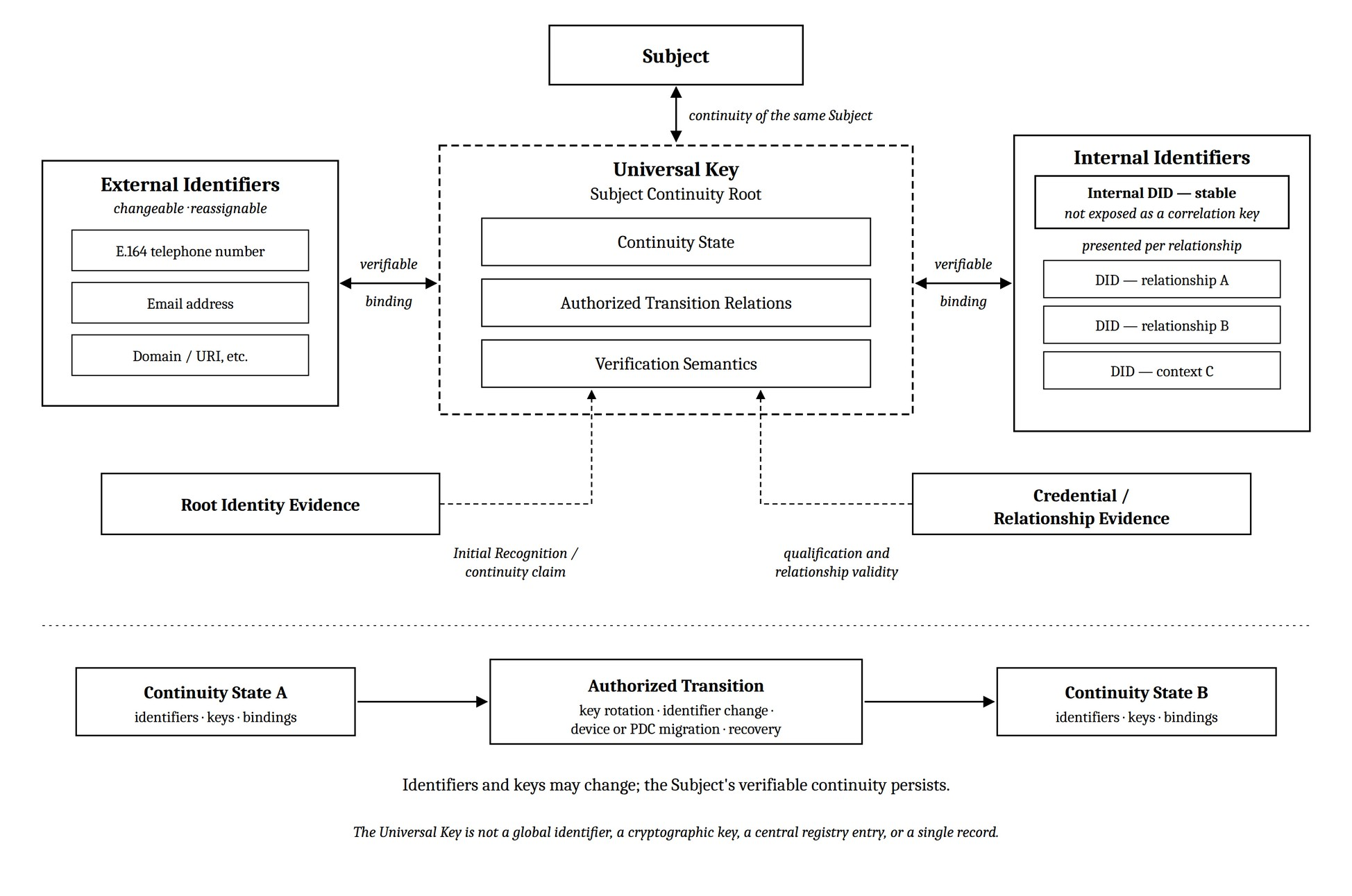
Figure 1 – Subject continuity root binding changeable external identifiers and internal identifiers (from [HWW-WP]). Ordinary transitions are recorded against the root; recovery after loss or reassignment uses pre-registered conditions (clause 6.3). Internal identifiers are stable relative to external ones but may themselves be rotated.
7.1 Capability is not authority
An increase in an agent's intelligence, autonomy or technical capability must not, by itself, create additional execution authority. An agent receives authority only through explicit, bounded delegation or a basis set by applicable law or rule, and it cannot issue, extend or approve its own delegation. A natural-language goal given to an agent is treated as intent, not as a grant: the agent may interpret it and propose actions, but a consequential action needs an explicit delegation, another basis of authority, or the Subject's approval. How a relying party in another domain verifies a basis set by law or applicable rule is an open question. Human oversight is preserved as far as the state of an action allows: the Subject can change or revoke a delegation at any time, and can take over a task without AI where the task state is held on the Subject's side. Whether an action already submitted can still be stopped or undone depends on its state, its reversibility and the systems executing it.
7.2 Minimum delegation semantics and security properties
For delegation to be interpretable across domains, a delegation artefact needs a small common set of semantic elements, independent of encoding:
the Subject to which the authority is ultimately attributed; the direct issuer, which may be the Subject itself, a representative authorized to act for an organizational Subject, or, for a re-delegation, the parent agent; and a reference to the parent delegation or to the representative's authorization;
the delegated agent, identified so that it can be authenticated when it acts;
purpose, permitted functions and scope;
counterparty or class of counterparties;
amount and cumulative limits, and where the cumulative state is held;
validity period, and conditions requiring further approval by the Subject, which may apply even within scope;
re-delegation permission (a re-delegation can never exceed its source) and revocation conditions, both inherited by any re-delegation;
whether the delegation depends on the continuing authority of the issuer (for example a representative) or stands until revoked by the Subject;
attribution of results and evidence back to the Subject.
Independent of encoding, a relying party should also be able to verify that the issuer was entitled to issue the delegation when it was issued and, where the delegation depends on the issuer's continuing authority, that this authority is still current; that the party presenting it is the delegated agent (for example by proof of possession of a key bound in the artefact); that the delegation is bound to the request and counterparty at hand, so that it cannot be replayed elsewhere or altered; and its current status. Separately from the validity of the delegation, the relying party should be able to ensure that a given request is executed at most once, for example through a unique transaction reference that the executing party checks and records atomically before execution, since a valid delegation does not by itself prevent the same request being submitted twice. Detailed security and privacy analysis is proposed as joint work in the relevant working group.
The list above is a starting point for common semantics, not a complete interpretation rule set. Comparison of constraints (for example currencies, accumulation periods and counterparty sets), handling of unknown or unsupported conditions, which should lead to refusal rather than silent acceptance, and resolution of ambiguity remain to be specified. Cumulative limits in particular cannot be enforced from the delegation chain alone when several agents act concurrently: an authoritative holder of the cumulative state, for example on the Subject's side, and reservation before execution, bound to the acceptance of the action, are needed, including a shared budget across re-delegations.
The same agent may hold different authority towards different counterparties. Authority is therefore a relation among Subject, agent, counterparty, context and time, not a permanent badge attached to the agent. Figure 2 shows the resulting chain.
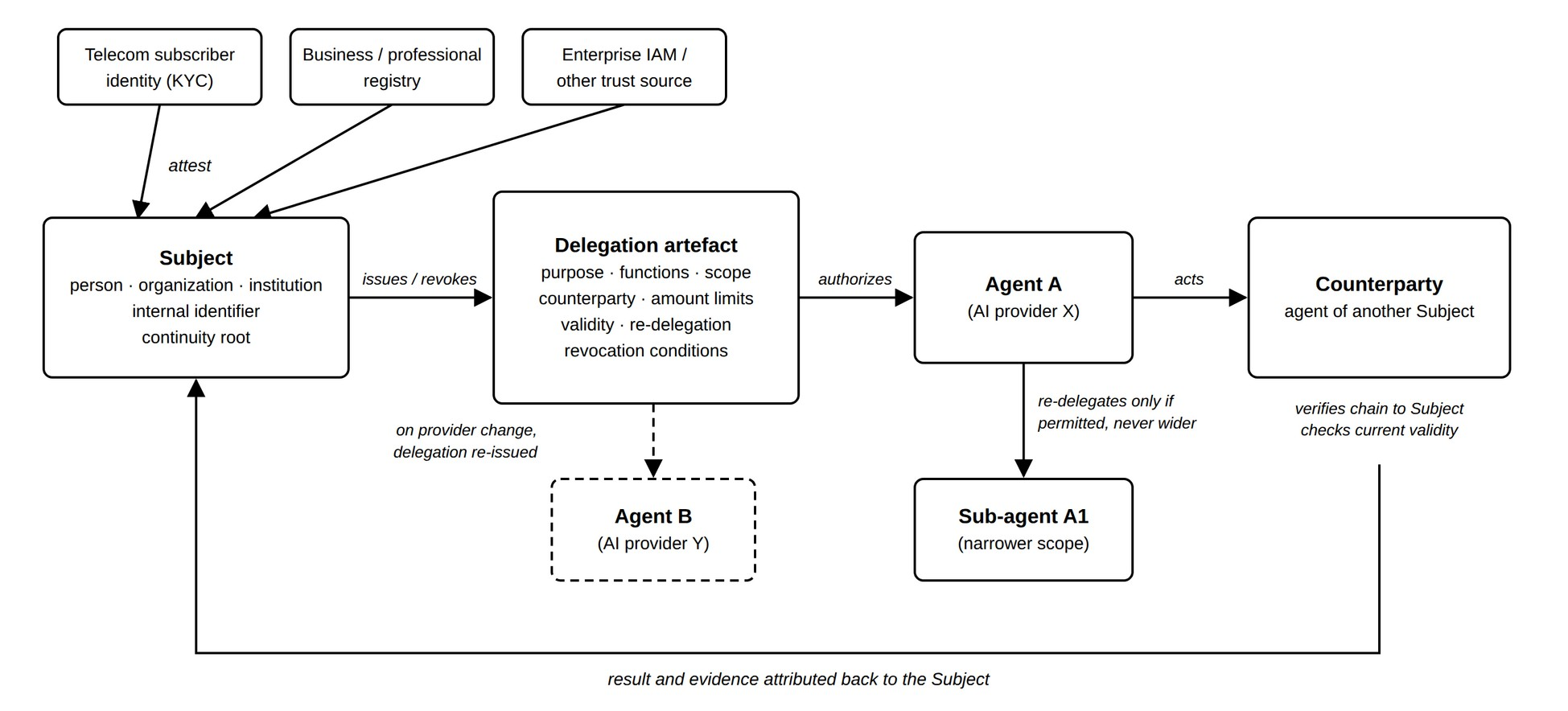
Figure 2 – Delegation chain: trust sources attest the Subject; the Subject issues and revokes bounded delegation; the counterparty verifies the chain and its current validity; results return to the Subject
7.3 Current validity and lifecycle
A delegation that was valid yesterday may not be valid now. Identity, trust evidence, delegation, authority scope, validity and resulting state should be distinguished, and authority should be re-checked immediately before a material action is executed.
Revocation ends the authority of the agent, and of any sub-agent depending on it, from the moment it takes effect, without affecting the Subject's identity or other relationships. The time at which a verifier observes that change depends on how status is published and on the freshness it requires. The architecture should therefore distinguish the time at which authority ends from the time at which a verifier can observe it, set freshness requirements according to the risk of the action, and specify what a verifier does when status cannot be obtained. The validation state at the time of an action should be preserved with its evidence, so that a later revocation is not mistaken for the invalidity of an earlier, legitimate action.
7.4 Subject-first discovery
Subject-first discovery covers two cases. When the counterparty is known, the relying side discovers and verifies that Subject, then the agents currently acting under it. When it is not known, a search by intent or capability returns candidate Subjects rather than agents, and agents are then located under the selected Subject. Discovery of unknown counterparties should be limited to Subjects that choose to be discoverable, typically organizations; natural persons should not be discoverable by intent or capability without their consent. Who publishes and indexes Subjects for such searches, and how the neutrality of discovery paths is ensured, are open questions.
Discovery is not trust: finding a Subject is followed by verification of its evidence under the relying party's own rules. Agent descriptors and registries remain useful, including discovery from well-known endpoints; they are not an architectural precondition, and temporary agents need not become permanent global discovery objects.
7.5 Accountability
Every action taken under valid authority remains attributable through an explicit chain: action → agent → delegation (or other basis of authority) → Subject. Actions without valid authority, for example after revocation, outside the delegated scope or by an impersonator, are still recorded with the evidence presented and the verification result, but they are not attributed to the Subject as authorized actions. The architecture does not determine whether a contract is formed or who is legally liable, which follow applicable law and the parties' terms. It preserves the evidence needed to determine them, including the validation state at the time of the action, after the agent itself has ceased to exist.
Clause 4.3 noted that where identity is held by the provider, dependence on an AI provider can extend into identity and relationships. This clause expresses the corresponding technical requirements as four properties of an identity and trust architecture, related to portability, resilience and interoperability, that can be assessed technically. They do not prescribe how operators are selected or how rule-making authority is allocated, which remain matters for applicable law and legitimate governance.
8.1 Subject control
The root of identity, relationships and delegation is held by the Subject, or by an operator acting under the Subject's authority, and not by the agent or its provider. Entrusting operation to a service operator does not transfer the Subject's identity or authority to that operator.
8.2 Provider independence
The Subject's identity and relationships do not depend on any one AI provider. When the provider changes, the Subject re-issues delegations to the new agent and revokes those of the old one; records and pending state need to be held or exportable independently of the provider, and counterparties still verify the new agent under their own rules; registering and authenticating the new agent and transferring state may still be needed. What is not required is re-establishing the Subject's identity with each counterparty. The analogy is number portability in telecommunications, under which the subscriber keeps the number when the operator changes.
8.3 Jurisdictional federation
Each jurisdiction keeps its own trust sources, data rules and acceptance policies, and the content of national identity systems is left untouched. Domains interconnect through common semantics for Subject anchoring, delegation and validity, so that a relying party in one jurisdiction can interpret the evidence and delegation of an agent acting for a Subject in another. Interpretation is not acceptance: whether a foreign issuer's keys, authority and assurance level are accepted remains the relying party's decision under its own rules, and the absence of an acceptable trust source is a normal outcome. No single global registry is assumed. This corresponds to Annex A.2.5 and relates to the cross-border trust architecture of A.3.2.
8.4 No single point of control
As a technical property, discovery, verification, registry and trust-source functions are separable and their configuration is verifiable, and no such function is designed as the sole path through which Subjects must pass to reach each other; alternative trust sources and migration between operators remain possible. Roles remain distinguishable even when one organization performs several of them.
These properties are proposed as assessment criteria under objective 3.4 and deliverable 4.5, alongside security, privacy, resilience, accountability and human oversight.
Table 2 compares the roles of several existing approaches against the requirements raised in this contribution. It assesses architectural roles, not quality: each approach is mature and useful within its intended scope. It does not claim that these approaches cannot be combined to meet the requirements; the question is whether a common profile across them exists. The classifications describe the scope and common requirements of the specifications reviewed, not the impossibility of satisfying the requirements through extensions, implementation choices or combinations of standards; and because the units compared differ — a family of OAuth specifications, one A2A artefact, one MCP component — the table analyses the role each plays, not the merit of one product against another. The comparison is offered as input to the gap analysis of objective 3.2 and Annex A.2.5.
Approach |
Primary role |
Subject anchoring |
Cross-domain delegation semantics |
Current validity and revocation |
Subject-first discovery |
Provider independence |
|---|---|---|---|---|---|---|
OAuth 2.0, Token Exchange (RFC 8693), Rich Authorization Requests (RFC 9396); OpenID Connect |
Delegated access and token exchange across security domains; fine-grained authorization details; user authentication |
Partial: subject identified per issuer; RFC 8693 distinguishes subject and actor |
Partial: cross-domain exchange and actor claims (nested actor claims informational only); RFC 9396 authorization details may carry amounts and payees; no common cross-sector vocabulary or cumulative-limit semantics |
Partial: expiry, introspection (RFC 7662), revocation (RFC 7009); caching windows |
Partial: OIDC Discovery with WebFinger resolves a user identifier to its issuer, not to the services acting for the user |
Conditional: identifier unchanged across a change of AI provider only while the same identity provider and identifier scope are kept; otherwise continuity needs a separate binding |
W3C DIDs and Verifiable Credentials, with Bitstring Status List |
Controller-held identifiers; verifiable claims from issuers |
Partial: DID controller may differ from DID subject; binding to a real-world Subject depends on evidence and verifier policy |
Partial: expressible as credentials; no common agent-delegation vocabulary |
Partial: status lists convey revocation or suspension of a credential, not the current scope of authority |
Partial: service endpoints from a known DID; no principal-first ordering for unknown counterparties |
Conditional: depends on DID method, key custody and recovery, wallet, issuers, status services and verifier acceptance |
A2A Agent Card |
Agent capabilities, endpoints and declared security schemes, for discovery |
Partial: the card may name, and be signed by, the providing organization; binding to the principal of a request is left to underlying mechanisms |
Not addressed: relies on declared schemes (OAuth, OpenID Connect, API keys, mutual TLS) |
Inherited from underlying mechanisms |
Not addressed: discovery of cards (well-known URI, registries, configuration), not the order of business discovery |
Not addressed: a card describes a deployment, not the principal's relationships |
MCP authorization |
Optional authorization of MCP clients to MCP servers over HTTP, based on the OAuth 2.1 draft; clients act for a user or, as client-credentials clients, on their own behalf |
Partial: a user who authorizes the client is represented at an authorization server, which may be separate from the AI provider |
Partial: OAuth scopes; tokens are audience-bound to each server and passthrough is prohibited, so each further hop needs its own authorization; no common multi-hop delegation semantics or cross-sector vocabulary |
Partial: tokens issued by the authorization server and validated by the MCP server; revocation left to the authorization server |
Not applicable: discovers authorization-server metadata, not principals |
Not addressed for Subjects; client identity may be a URL-based metadata document usable across authorization servers |
SPIFFE, with SPIFFE Federation |
Workload identity within and, by federation, across trust domains |
Not addressed: identifies workloads, not the Subject |
Not addressed |
Partial: short-lived credentials and trust bundles |
Not addressed |
Not addressed for Subjects; workload identity is portable and federates between trust domains |
Operator subscriber identification, E.164 numbering and number portability |
Operator verification of subscribers; international numbering plan and reachability |
Partial: assurance varies by jurisdiction, operator and subscription type; subscriber of record may differ from the user |
Not addressed |
Partial: subscription status within the operator |
Partial: reachability of the subscriber, not of its services |
Conditional: the number can be retained where portability exists; other relationships are not covered |
Each approach keeps its role inside the proposed model: OAuth and token exchange can carry delegated access, including across domains; DIDs and Verifiable Credentials can carry internal identifiers and trust evidence; agent cards can describe what an agent under a Subject can do; MCP authorization can govern access to tools; workload identity can authenticate the agent runtime; and subscriber identification can act as a trust source. Among the specifications reviewed here, we have not identified a common profile across them that provides Subject-anchored delegation semantics that a relying party in another domain or sector can interpret, including cumulative limits and re-delegation constraints; a common expectation for checking current validity at the moment of action; continuity of the Subject across changes of identifier and provider; and Subject-first discovery. This is offered as a gap hypothesis rather than a conclusion: whether such a profile already exists in specifications or deployments not reviewed here, and whether existing mechanisms combined under it are sufficient, are questions this contribution proposes FG-TIDA to study.
Several further bodies of work bear directly on parts of this hypothesis and should be included in that study: capability-based delegation formats in which delegation can only be attenuated (for example UCAN, ZCAP-LD, macaroons and Biscuit); signed mandates for agent payments whose constraints a verifier checks against the user's intent (for example the checkout and payment mandates of the Agent Payments Protocol, AP2 v0.2, in its human-not-present mode); trust chains across federations (OpenID Federation 1.0); propagation of call context through service chains (OAuth Transaction Tokens and the IETF WIMSE work); resolution of a user identifier to its issuer (WebFinger, RFC 7033, in OpenID Connect Discovery); and operator interfaces for number verification and SIM-swap signals (CAMARA). References for these works are listed at the end of this document. Taking these into account, the gap that most plausibly remains concerns a shared cross-sector vocabulary for delegated authority, an authoritative holder of cumulative state, continuity of the Subject across identifiers and providers, and the Subject-first ordering of discovery.
Each case is written to show the same thing from a different side: what a function-centric arrangement would have to share, and what the Subject-centric model makes unnecessary once the Subjects on each side can verify each other.
10.1 A citizen agent and a public-service agent
A citizen asks an AI assistant to apply for a public service. In a registry-centric agent arrangement the assistant and the institution's service agent are enrolled in a common agent registry or directory, and the citizen's standing is inferred from the assistant's account. Here neither is required.
The citizen's E.164 number is bound to an internal DID on the basis of the operator's subscriber identification and a check of current control of the number.
The citizen delegates to the assistant a bounded authority: purpose, the specific service, period, and a rule that any fee above a threshold requires the citizen's confirmation.
The assistant discovers the public institution as a Subject, verifies its evidence, and then locates the service agent operating under it. The same holds in the other direction: if the citizen starts from a service agent found by its function, the assistant resolves the institution behind that agent and verifies it before any exchange proceeds.
The public-service agent verifies the chain citizen → delegation → assistant and its current validity, which establishes that the assistant may act for the citizen. Separately, it checks the citizen's eligibility and the required evidence under its own rules, and processes the application within the delegated scope.
The result and its evidence are returned to the citizen. If the citizen later changes AI provider, the citizen re-issues the delegation to the new assistant and revokes the old one; the citizen does not need to re-establish identity with the institution, and the institution changes nothing in its own setup: it verifies the new assistant under the same rules; the new assistant may still need to be registered and authenticated by its own provider.
What the Subject-centric model changes here: the citizen and the institution never share an agent system, and the assistant can be replaced without touching the relationship. What is reused is the operator's subscriber identification and the institution's own eligibility rules; what is added is one bounded delegation with a human-approval condition.
10.2 Enterprise procurement with re-delegation
Three agents with different roles — a procurement agent, a quotation sub-agent and a supplier's sales agent — are aligned by one Subject chain; the supplier authenticates each agent it faces and verifies it against Company K's chain, and trusts none of them as a root. A procurement manager of Company K delegates to a procurement agent the authority to buy industrial sensors from qualified suppliers, within a per-order amount and a monthly cumulative limit, with contracts above a threshold requiring the manager's approval.
Company K is attested by a business registry. Company K's internal authorization records that the manager may commit the company for this category and budget; the manager's role is attested by the company's enterprise identity system, but the role alone is not taken as authority to commit. The manager issues the delegation as a representative authorized by Company K, which remains the Subject to which the authority is attributed.
The procurement agent re-delegates to a sub-agent the authority to collect quotations only. The sub-agent's delegation excludes any commitment.
A supplier's sales agent verifies the chain Company K → authorization of the manager → delegation → procurement agent, and accepts the order only together with a reservation of the amount against the cumulative state held on Company K's side (one approach to the cumulative-limit problem), so that concurrent orders cannot both consume the same remaining limit. Each order carries a unique reference that the supplier's system checks and records atomically; a retried submission with a reference already accepted is not executed again, and the original result is returned.
When the sub-agent attempts to accept an offer, the supplier refuses, because its delegation does not include commitment.
When the manager changes role, Company K's rules end the manager's purchasing authority. Because Company K's policy makes delegations issued by a representative depend on the representative's continuing authority, and Company K also revokes the delegation explicitly, the procurement agent and its sub-agent lose authority from that moment; the supplier observes the change within the freshness it requires for orders of that size and refuses orders once it has observed it. Company K's identity and its supplier relationships are unaffected.
What the Subject-centric model changes here: agents of different roles and depths are ordered by one chain rooted in Company K, so that pulling the root — ending the manager's authority — brings every branch with it, and the supplier authenticates the agents it talks to but never has to trust any of them as a root. Cumulative limits and revocation are checked against Company K's authoritative state, at-most-once execution against the supplier's own execution record, the two bound by the order reference — neither against any agent's.
10.3 Cross-border trade between small businesses
A small manufacturer in the Republic of Korea sells components to a buyer in Germany. Each side uses an AI agent from a different provider, under a different identity system, with trust sources from a different jurisdiction. In a registry-centric agent arrangement the two agents meet in a shared registry and a shared trust framework before doing business. Here the two sides share neither a registry, nor an identity system, nor a provider; what they must both support is the Subject-level verification, the interpretation of the few delegation elements that follow, and the current-validity checks those elements require — and whether a foreign trust source is accepted remains each relying party's decision (clause 8.3).
The buyer's agent searches by product and terms, obtains candidate manufacturers as Subjects, and then locates the agents of the selected manufacturer.
The manufacturer's trust evidence comes from Korean trust sources: the business registry and the operator's subscriber identification. The buyer's side decides, under its own rules, whether to accept these foreign trust sources.
Both agents present delegation artefacts with the same minimum semantics (clause 7.2). What both sides must support is the interpretation of those delegation elements, the verification of each other's evidence and the current-validity checks; each side keeps its own identity system, trust sources and AI provider, and the agents talk over whatever agent protocol both support under the conditions of clause 5.3.
Verification of authority supports, but does not by itself decide, whether a contract is formed; that follows the applicable law and the parties' terms. Data exchanged in the transaction follows the rules of each jurisdiction.
Later the manufacturer changes AI provider. It re-issues its delegations to the new agent and revokes the old ones; the buyer's relationship with the manufacturer continues without re-establishing the manufacturer's identity.
What the Subject-centric model changes here: four things differ between the two sides — provider, identity system, trust sources and jurisdiction — and none of them had to be aligned. The two Subjects were found and verified, the delegation elements were read with a common interpretation, and everything below that stayed local. This is the case for jurisdictional federation without a global registry (cf. Annex A.2.5, A.3.2).
10.4 A patient agent and a hospital
A patient's assistant contacts a hospital. The hospital exposes a front-desk agent and, behind it, agents for appointments, clinical questions and billing, each with a different role and a different data boundary.
The assistant verifies the hospital as a Subject and verifies that the front-desk agent acts under it; nothing about the hospital's internal agents has to be known in advance.
Once the two Subjects have verified each other, the front-desk agent hands the assistant to the appointment, clinical or billing agent as the patient's request requires, in the way a voice menu routes a call. Each of these agents acts under the same hospital Subject; the assistant authenticates the agent and verifies its binding to the hospital Subject and its currently valid authority, without re-establishing the hospital's identity and trust basis.
The patient's assistant and the hospital's agents share no identifier system, registry or trust framework; what they share is the protocol over which they talk once routed, under the conditions of clause 5.3. Data disclosed to the billing agent is scoped to billing, under the patient's delegation, and is not thereby available to the others.
What the Subject-centric model changes here: taking hold of one branch — any of the hospital's agents — leads back to the same trunk. The hospital's identity and trust basis are verified once and are not re-established for each agent; what remains per agent is the check that it acts under the hospital, with what delegation and what current authority, which matters all the more where clinical data is involved. The hospital can add, split or replace its agents without the patient's side re-establishing the hospital's identity or trust basis; each new agent is still authenticated and checked for its binding and authority.
PAX S&T proposes that FG-TIDA:
Terminology: consider the working definitions in Table 1, in particular the role of the Subject as distinct from the delegated agent, and the separation of identity, delegation, authority, current validity and attribution, aligned with existing ITU-T terminology.
Architecture: consider a Subject-anchored model in which agent identifiers may be local, domain-specific or ephemeral, and in which the cross-domain requirement is placed on Subject anchoring and delegation semantics rather than on a universal agent identifier.
Delegation artefact: consider the minimum semantic elements and security properties of clause 7.2, including the rule that a re-delegation can never exceed its source, as input to the study of delegation-artefact properties; and, within the trust lifecycle, the recovery conditions of a Subject continuity root after loss, compromise or number reassignment (clause 6.3).
Discovery: document Subject-first discovery, for known and for unknown counterparties, as an architectural pattern alongside agent descriptors and registries.
Assessment criteria: include the principle that capability does not create authority, and the four properties of clause 8, among the criteria for trustworthiness and interoperability.
Gap analysis and existing identity reuse: use Table 2 as an input to the gap analysis, and study whether existing mechanisms combined under a common profile meet the requirements, including how existing identity systems can act as trust sources without a new global registry.
Use cases: include the four use cases of clause 10 in the FG-TIDA use-case collection.
A follow-up contribution on the interoperability layer — how Subjects that have verified each other let their agents work over an existing agent protocol or an interoperability profile, under the conditions of clause 5.3, and how the carrier for a given correspondence is settled in negotiation — is in preparation against Deliverable 4.2 and Annex A.1.6 and A.2.7.
Proposal |
FG-TIDA objective / deliverable |
Clauses of this contribution |
|---|---|---|
1 Terminology |
Objective 3.1 |
3 |
2 Architecture |
Deliverable 4.2; Annex A.1.1 |
5, 6 |
3 Delegation artefact and lifecycle |
Deliverable 4.3; Annex A.1.2, A.1.3 (cumulative limits in payment use), A.2.2, A.2.4 (human approval conditions); partial contribution to A.2.7 (cumulative state, revocation propagation) |
6.3, 7.1–7.3 |
4 Discovery |
Deliverable 4.2; Annex A.1.1, A.3.2 |
7.4, 10.1, 10.3, 10.4 |
5 Assessment criteria |
Objective 3.4; Deliverable 4.5 |
7.1, 8 |
6 Gap analysis and existing identity reuse |
Objective 3.2; Annex A.2.5 |
6, 9 |
7 Use cases |
Objective 3.3; Deliverable 4.1; Annex A.2.5 (related: A.3.2) |
10 |
— Interoperability layer (follow-up contribution, not among the seven proposals above) |
Deliverable 4.2; Annex A.1.6, A.2.7 |
5.3 (this document); follow-up contribution |
PAX S&T is prepared to contribute further text, including detailed use-case descriptions and a reference architecture, to the relevant working groups.
An agent is both a function and a delegate, but it is rarely the ultimate holder of authority or responsibility. Treating each transient agent as an independent root of authority ties persistent trust to the most volatile entities in the system and can place the Subject's relationships in the hands of whoever runs the agent. Anchoring identity, trust and accountability to the persistent Subject, while letting agents remain bounded and replaceable delegates, is intended to keep agent identifiers flexible, to reuse the trust that existing identity systems already carry, to allow providers to be changed without re-establishing the Subject's identity, and to make the relationships that matter interpretable across domains and borders. The detail that remains to be settled — recovery procedure after loss or reassignment, and the operation of discovery — refines the model rather than conditioning its proposal; continuity through a recovery path is claimed only once a deployment has defined that path. It is submitted for study in clause 11.
In accordance with the ITU-T Common Patent Policy, PAX S&T Co., Ltd. draws the attention of the Director of TSB and of the Focus Group to Korean Patent No. 10-2990000 and International Patent Application PCT/KR2026/012600, held by PAX S&T Co., Ltd., which may relate to concepts described in this contribution. PAX S&T Co., Ltd. intends to make licences available on reasonable and non-discriminatory (RAND) terms and conditions, and will submit an ITU-T General Patent Statement and Licensing Declaration. This notice is not a substitute for that declaration and does not imply that any patent is essential to a future Recommendation.