Verifiable facts for initial trust establishment between agents of parties with no prior relationship
Contribution number FG-TIDA-INCUBATION-003
Versions:
| Document | Author(s) | Victor Davidenko |
|---|---|---|
| Submitted by | Victor Davidenko | |
| Affiliation(s) | Scarp Protocol Inc., Canada | |
| Submission contact | victor@scarpprotocol.com | |
| Version | 0.1 · recorded | |
| Last updated | 2026-11-17 19:54 UTC | |
| Formats | ZIP Text | |
| FG-TIDA workflow | State | Submitted |
| Working group / stream | NWI for Incubation | |
| History | Decisions and changes · latest activity 2026-11-17 19:54 UTC | |
| Secretariat | tsbfgtida@itu.int |
Repository creation follows working-group adoption.
Archived versions
| Version | Recorded | GitHub tag | Release artifacts |
|---|---|---|---|
| 0.1 | 2026-11-17 19:54 UTC | — | — |
This reading preview includes the RST chapters and their referenced images. Download the source ZIP for the complete folder structure and supporting files. Submitted build configuration and diagram source files are not executed in this preview.
Contribution to FG-TIDA proposing a new work item
Abstract
AI agents will soon negotiate, transact and collaborate for people and organizations that have never dealt with each other. This input asks which facts each side must verify, and who must vouch for each fact, before trust can form. It proposes fifteen checks: nine before the parties deal at all, six before a binding agreement forms. At initial trust establishment, before any behaviour, these facts link identity to trustworthiness. They carry no score: each relying party decides under its own policy. A competent issuer signs each fact; relying parties recognize issuers, which can include a national registry, through lists of eligible issuers. Four properties are stated, not a design: no single registry or resolver that all must use; portability across agent operators; a person's legal name only where national law requires it; and a signature on every request that seeks more than anonymous access. No new protocol, law or regulation is proposed: existing standards, including ITU-T X.509, can carry, sign, check and log the statements, though their content needs agreed formats. This input proposes a technical report built on these checks as a new FG-TIDA work item, with the contributor as its editor, and invites members to challenge any check. No working group holds this subject yet, and the contributor offers it to the trust control plane group proposed in FG-TIDA theme #59.
History
Version |
Document |
Approval |
Focus Group |
Working Group |
|---|---|---|---|---|
0.1 |
Verifiable facts for initial trust establishment between agents of parties with no prior relationship (contribution, November 2026) |
Not approved |
TIDA |
Not yet allocated |
Authors
Name |
Affiliation |
Contact |
|---|---|---|
Victor Davidenko |
Scarp Protocol Inc., Canada |
Keywords
agentic AI; cross-border trust; initial trust establishment; relying party; trust framework; verifiable attestation
Foreword
Agentic AI systems now act as autonomous entities capable of reasoning, planning, and executing tasks across services, infrastructures, and organizational boundaries. This fundamentally changes the nature of identity in digital systems: identity is no longer limited to human users and static machine instances but must also encompass autonomous, dynamic, and goal-oriented agents. And identity alone is insufficient — the core question extends beyond "what an entity is" to "whether, and under what conditions, that entity should be trusted to act".
The Focus Group on Trust and Identity for humans and agentic AI (FG-TIDA) addresses trust management and interoperable digital identity infrastructure for humans and for agentic AI, supporting the development of secure, trustworthy digital ecosystems in which humans and agentic AI can safely interact and collaborate.
FG-TIDA was established under Recommendation ITU-T A.7 (Focus groups: Establishment and working procedures), with ITU-T Study Group 17 as its parent group. Further details are available in the group's terms of reference.
For more news and updates about the TIDA Community, including its supporter organizations, please refer to the community's published resources.
The question
FG-TIDA Co-Chair Debora Comparin has said that "AI agents will soon negotiate, transact and make decisions on our behalf" [b-ITU PR]. The focus group's Terms of Reference add that where agents operate across organizational and jurisdictional boundaries, "trust cannot be established or enforced by a single authority" [b-FG-TIDA ToR, clause 1].
Two agents meet on behalf of parties that have never dealt with each other. No platform, contract or authority links them, and neither has any reason to trust the other. Before they negotiate, transact and make decisions on anyone's behalf, each must establish what is true about the other. This input asks one question: which facts must each side be able to verify, and who must vouch for them, before any trust can form?
The question is open. The Terms of Reference note that existing identity and trust frameworks were designed mainly for human users or static services, and do not fully address dynamic delegation or interaction between agents at scale [b-FG-TIDA ToR, clause 1]. Existing schemes can each carry signed statements. The closest published list the contributor found is Annex VI of the amended eIDAS Regulation, which names attributes, such as age, powers and mandates to represent, permits and licences, and company data, that qualified trust service providers must be able to verify against authentic sources [b-eIDAS]; it does not address agents. SG17, the focus group's parent group, has work items in development on agentic AI identity, among them terminology and design guidelines (X.dpidm-aAI) and a canonical identity data model (X.aiidm) [b-ITU-T SG17 LS160]. The contributor found no published profile that lists which facts a relying party needs about an agent it has never met, and who is competent to sign each; this input offers a starting list.
Several FG-TIDA theme proposals raise parts of this question. Theme #3 asks what information is required to establish trust between unknown agents operating across jurisdictions [b-FG-TIDA #3], and theme #29 asks what evidence a counterparty can inspect when the parties operate under independent authorities [b-FG-TIDA #29]. Theme #47 asks for information beyond identity, from sources such as the agent's supplier, a supervision authority or a certification authority, so that relying parties can assess risk [b-FG-TIDA #47].
This input uses four terms. A fact is what a competent issuer has checked about a party, and a statement is the signed record of a fact. The principal is the person or organization an agent acts for. The agent operator is the service that runs the agent for its principal: it is named on every request and acts on reports of abuse, and it is not thereby liable for the principal's agreements, which law and contract decide. Each side is a relying party for the other, a term the Terms of Reference use [b-FG-TIDA ToR, clause 2]. The question is the same whether that side is a public authority, a business or a person. An ITU and World Bank Group article on digital public services describes one of these facts, the principal's authorization, from the position of a public authority: before acting on an agent's request, an authority needs to know whether the person or business it claims to act for genuinely authorized it [b-ITU WB].
Between identity and trustworthiness
Co-Chair Amir Banifatemi has drawn the distinction this input builds on: "Identity tells us who is acting and trustworthiness tells us how that actor can be expected to behave" [b-ITU PR]. Between strangers, neither side has yet seen the other behave, so at first contact each can rely only on facts that others have checked and are accountable for. One of these facts is the principal's record: a list of past outcomes that others have signed, such as completed deals and published decisions, and not an evaluation of behaviour.
These facts are the evidence a relying party has about how the other side can be expected to behave before it has seen any behaviour. They show who is accountable for the agent and what the principal allowed it to do. They also show what restrains the agent and what the principal's record contains. In this sense they connect identity to trustworthiness when trust first forms, the stage the Terms of Reference call initial trust establishment [b-FG-TIDA ToR, Annex A, A.2.2]. Continuous trust evaluation, also part of deliverable 4.3 of the Terms of Reference, takes over once there is behaviour to observe, and lies outside this input.
Human oversight (Annex A, A.2.4) enters this input as facts: the limits the principal set on what its agent may do, and the enforcement that can stop an action. How a person intervenes while the agent runs lies outside this input.
The facts tell a relying party what others have verified about the other side, and they carry no score. Each relying party answers under its own policy the question the Terms of Reference place at the centre: "whether, and under what conditions, that entity should be trusted to act" [b-FG-TIDA ToR, clause 1].
Scope
Figure 1 shows where this input sits. Agents meet and verify each other, and then negotiate. They then transact or collaborate under what they agreed, and finally settle. Settlement completes the exchange: payment or delivery, and who bears the loss if either fails. How agents negotiate, transact, collaborate and settle lies outside this input. Agentic AI protocols are outside the Terms of Reference (clause 2). Trust evaluated from behaviour is the subject of deliverable 4.3 and of the example study in Annex A, A.2.8. That work can start from the facts in this input.
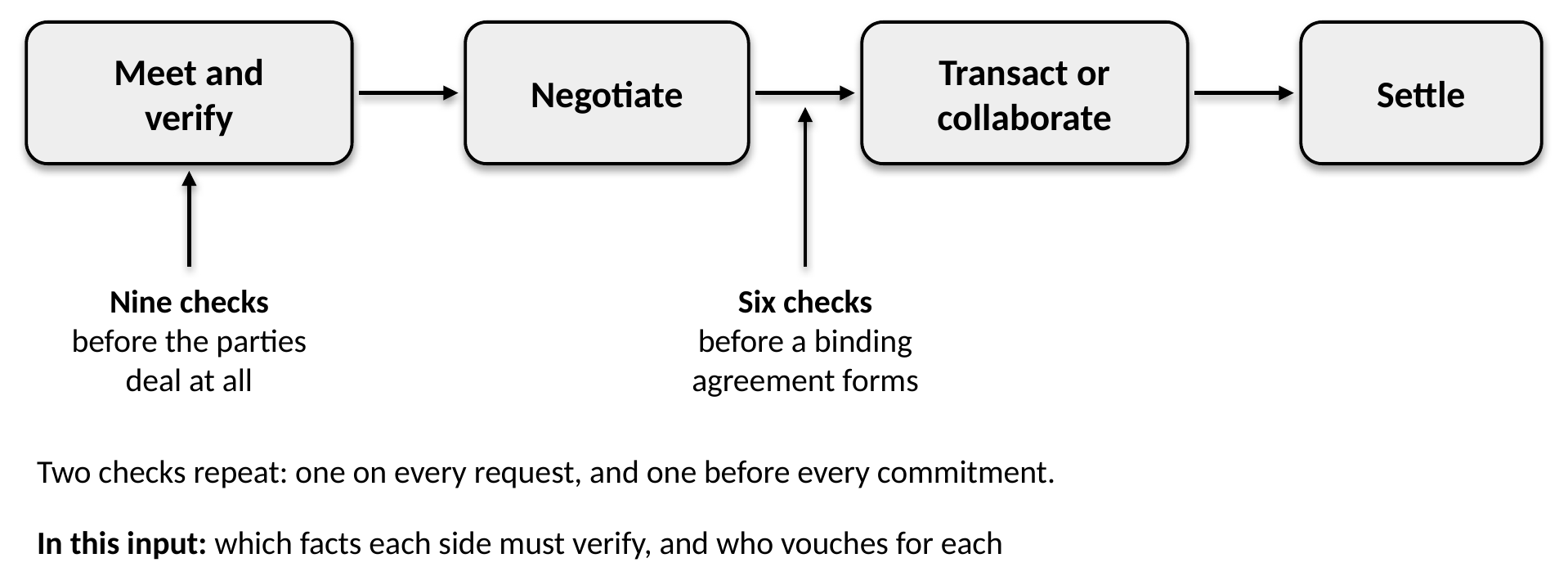
Where the checks in this input apply
This input proposes no new protocol, law or regulation. Clause 2.4 names existing standards that can carry the statements, with the reason for each choice. The Terms of Reference treat digital ID and its content as a national matter outside the scope of ITU [b-FG-TIDA ToR, clause 2]. This input takes national identity documents and registers as they are, and asks how a relying party in another country can recognize the statements their issuers sign.
Beyond commerce
The exchange does not have to involve money. In this input, a deal is any agreement between the two sides, and a purchase is only one kind. The same checks apply when agents and other participants:
collaborate, for example when research groups in different organizations work on one task and share its data and results;
delegate, when a principal gives an agent the authority to act for it, within limits the principal sets;
share a workload, when an agent splits a task into parts and brings other agents in to do them;
work as a swarm, when many agents or devices, often acting for different principals, coordinate as one group, such as drones that inspect a power line together;
exchange data, including streams of sensor readings and data used to train or feed a model;
act in the physical world, when a robot, a vehicle or a drone asks to enter a site or to join a task.
In each case, every participant shows the same kinds of facts. They say what kind of participant it is and who is accountable for it. They also say what it may do, what restrains it, and where its software and data come from. When many participants work together, each one carries its own facts, so a relying party can check every member of the group, not only the one that contacted it. When one principal's work passes from agent to agent, no agent receives more of that work or data than the principal gave.
Where no money changes hands, the relying party's policy can leave out the checks that concern payment and tax, and the rest still apply. Sectors with rules of their own, such as health or critical infrastructure, can run the same checks with only the issuers that their own lists name.
What each side must be able to verify
The fifteen checks in Table 1 come from asking what a relying party that has never met the other side must verify at two moments: before it deals with the other side at all, which gives checks 1 to 9, and before a binding agreement can form, which gives checks 10 to 15. Two checks repeat: check 6 before every commitment, and check 9 on every request.
Table 1 uses the word "participant" for the other side, because the other side is not always an agent. It can also be an AI model, a robot, a sensor or a data source. In check names, "binding" means a verified link. Each row of Table 1 states what the relying party verifies and, after the word "so", the failure the check prevents.
# |
Check |
What the relying party verifies, and the failure it prevents |
|---|---|---|
1 |
Entity classification |
What kind of participant it is, such as an agent, an AI model, a robot, a sensor or a data source, whether its principal is a person or an organization, and in which role a person acts, so the relying party applies the rules it sets for each kind and knows which of the other checks to run, such as the certification of a sensor or a data source on whose output its decisions depend, turns away kinds its work must not admit, and applies the rules that differ for persons and organizations |
2 |
Technical-policy enforcement binding |
That technical-policy enforcement outside the agent checks each of the agent's actions against the rules its principal set, such as where data may go, and can stop the action, and that an independent party signs a statement about that enforcement, so the relying party does not open its data or systems to an agent that nothing outside it restrains |
3 |
Ownership with portable track record |
What the principal has done before, under any earlier key, agent operator or owner: the deals it completed, and any published decisions against it by a court, a regulator, a certifier or a dispute body, so the relying party can judge a stranger by its record, and a principal with violations cannot hide them |
4 |
Concurrent delegation |
When one agent acts for many customers at once, which customer is its principal in this exchange, so the relying party knows exactly whom the deal binds, and learns whether the same agent also acts for the relying party's side |
5 |
Provenance and certification |
Which model, firmware or software the participant runs, who produced it and which independent certifier examined it, and, for data, which source signed it and whether that source is certified for that kind of fact, so the relying party can refuse a participant unless a certifier that it recognizes has examined it, can refuse one whose software was replaced after the examination, and can rely only on data whose source it can verify |
6 |
Compromise response at machine speed |
Before every commitment, whether any key or statement the deal relies on has been revoked, so the relying party does not accept a commitment made with a stolen key, or one made by the agent of a dissolved organization |
7 |
Output provenance |
Who produced an output, when, for whom it was meant and when it expires, even after other parties have passed it on, so a forged output is detected, and no output is relied on by a party it was not meant for or after it expired |
8 |
Jurisdictional and tax binding |
Where the principal is established and in which countries it is registered for tax, so the relying party applies the right tax, duties and rules when the deal is made, and does not have to work them out afterwards |
9 |
Self-identification at the network boundary |
On every request, that the client is an agent and who is accountable for it, so the relying party can apply its policy to agent traffic before the agent acts, and an agent that hides gets only what an anonymous visitor gets |
10 |
Actions classification |
Which kinds of agreement the principal allowed the agent to sign, and which licences the principal holds, so the relying party does not enter a kind of deal that the principal never allowed, and that therefore might not bind the principal, nor one that the law reserves to licensed parties |
11 |
Commitment authority and capacity |
That the principal allowed a deal of this size, and that the money for it is reserved or the credit approved, so the relying party does not enter a deal larger than the principal allowed, or one that goes unpaid |
12 |
Data handling certification |
Which kinds of sensitive data, such as health or payment card data, an accredited certifier has certified the agent and its infrastructure to handle, so the relying party sends each kind of data only to agents certified for it |
13 |
Insurance and liability |
Which insurer provides coverage for harm the agent may cause, and whether that coverage protects the relying party, so a covered loss is paid even when the principal cannot pay it |
14 |
Multi-agent workflow authorization |
Whether the agent may work alone, join a team of agents or coordinate one, and the chain of consents that links each agent in the team back to the principal, so the relying party can check that each agent brought into the work received no more of the principal's work or data than the principal gave, and can refuse any commitment such an agent offers in the principal's name |
15 |
Dispute resolution binding |
Which courts or dispute bodies the principal accepts, and under which rules, so the relying party knows before the deal where it can enforce a claim |
Checks 2, 4, 5, 6, 7, 9 and 14 arise because the other side is autonomous software. Its code can change (check 5), and it can act beyond what its principal intended (check 2). Its keys can be stolen (check 6), and its outputs travel beyond the exchange that produced them (check 7). One agent can act for many principals at once (check 4), and can pass work on to other agents (check 14). A relying party cannot tell that a client is an agent unless the agent says so (check 9).
The contributor applied a removal test to every check: a fact stays on the list only where leaving it out causes a failure that no other check prevents. Clause 2.5 applies the test to each check. Each check is a technical requirement: what the relying party's software must be able to verify. The legal and business content of each fact stays with its competent issuer (defined in clause 2.2).
The checks cover what a relying party needs to know about the other side, not how the other side manages itself. Check 11 is the clearest example. It tells the relying party that the principal allowed a deal of this size, and that the money for it is reserved or the credit approved. No check shows how much the principal has committed across all its deals. The contributor considered four ways to keep that running total:
show the principal's open commitments as a statement a relying party can verify. This was declined, because the figure would be out of date as soon as another deal formed, and it would show every stranger how much business the principal does;
let each relying party keep the total. This was declined, because a relying party sees only its own deals with the principal;
keep a central register of every principal's commitments, which every relying party would consult. This was declined for four reasons:
like the first option, its figure would be out of date as soon as another deal formed;
until a deal is signed, no money is committed, so a register that held money for deals still being negotiated would make other deals, closed faster, fail;
an adversary could open deals it never meant to close, only to hold the principal's money and block its real business, and such attacks would be hard to prevent;
it would be one register that every relying party in every country must consult, the kind of single point that the first property in clause 2.3 avoids;
leave the total with the parties that see every commitment: the principal's own systems, which approve each commitment before the principal signs it, and the party that holds the money, which reserves it only when a deal is signed, and only for that deal. This option was chosen.
The choice prevents four failures:
an agent spreads deals across many relying parties, each within the limit, until together they exceed what the principal can bear. The principal's own systems see every commitment before it is signed, so they can stop this;
the same money is promised to two relying parties. The party that holds the money reserves it for one deal at a time, so this cannot happen;
money is held for deals that never close, and the principal's real business is blocked. Money is reserved only when a deal is signed, so this cannot happen;
a relying party acts on an out-of-date total, or learns how much business the principal does. No running total is ever published, so neither can happen.
Of the options considered, only this one keeps the total current and private without holding money for deals that are not yet signed. Companies already divide the work this way. A supplier checks only that the buyer in front of it may sign an order of this size, while the buyer's own company keeps count of everything its buyers have ordered.
Who vouches for each fact
Each fact in Table 1 is signed by a competent issuer: a party, public or private, that the law, or a scheme the relying party accepts, treats as authoritative for that fact, and that is accountable for what it signs under that law or scheme. Table 2 gives examples. What a participant says about itself can justify refusal, and never trust: a relying party extends trust only on a statement from a competent issuer. The principal is not the participant. A principal's signed statement about the authority it gives its agent is the principal's own commitment, and its legal effect depends on the applicable law. The party that operates the principal's technical-policy enforcement signs only how an output was produced, and an independent party signs a statement about that enforcement (check 2).
Competent issuer |
Competent for |
|---|---|
Certification authority, which binds keys to their holders |
The binding of a key to its holder, and what it checked when the principal enrolled |
Government body that issues identity documents |
A person's identity and age |
Official register |
What it records about an organization |
Trust service provider relaying a register |
Which register it read, when, and what the register said |
Principal |
The authority it grants its agents, and its own commitments |
The party that operates the principal's technical-policy enforcement |
The conditions under which an output was produced |
Bank |
The capacity it provides |
Insurer |
The coverage it underwrites |
Certifier, which examines software, devices, data sources or data handling |
What it certified |
Regulator or tax authority |
The licence or registration it granted |
Dispute body |
The outcome it decided |
A relying party recognizes these issuers through lists of eligible issuers. Each list names the issuers its keeper accepts for one kind of fact. Lists can be kept by governments, sector bodies or software suppliers. Any country can publish its own list, and publication does not oblige a relying party in another country to follow it. Each relying party chooses which lists to follow; a household will usually follow those its government or its software supplier selects. Following a list does not by itself require a relying party to join a federation or sign a contract. The ITU and World Bank Group article describes mutual recognition across borders as an aim [b-ITU WB]. In the contributor's view, lists of this kind could support that aim; they do not replace agreements between countries. Each statement must use a format that software can evaluate. The relying party's policy decides which checks a decision needs, and may require fewer for a low-risk decision. Its software makes those checks in one procedure, and if any of them cannot be completed, it refuses the agreement rather than proceed on an assumption. A person needs no business credentials: licences, insurance and tax registration are asked of organizations and of persons who trade, and a purchase by a person's agent may need few checks. Where a country has no competent issuer for a fact, its participants cannot pass a check that needs that fact; members are invited to report such gaps under deliverable 4.1.
Because recognition works fact by fact, the checks do not depend on who issues identity documents or agent identifiers. Where national law requires a relying party to consult a national registry, the relying party does so, and that registry is one of its competent issuers. Nothing in this input asks any country to change how its registry works.
One framework of competent issuers operates worldwide today, for organizations. In several countries, governments or legislators are building or considering registries of agents, or official identities for agents. The verifiable LEI lets an organization prove its Legal Entity Identifier and the roles of the people who act for it, with credentials issued under a framework that GLEIF administers [b-GLEIF vLEI]. In China, national guidance of May 2026 called for exploring an agent registration platform [b-CAC], and a platform for registering and resolving agent identities was released at a forum of the World Internet Conference Wuzhen Summit on 4 November 2026 [b-STD]. In June 2026, an advisory board set up by Estonia's Prime Minister agreed that Estonia will move forward with digital identities for agents, so that an agent acting for a person or a company can be given limited and controllable powers [b-EE]. Singapore's government is building an internal registry of the agents its public agencies deploy, and is assessing whether a national registry is needed [b-SG]. A bill introduced in the United States Senate in July 2026, and in committee as of November 2026, would have the Federal Trade Commission keep a registry of providers of agents that act for users [b-US S.5051]. Any registry of this kind could serve as a competent issuer for the facts it records, for the relying parties that recognize it, directly or through a trust service provider that relays it (Table 2).
The properties the verification must have
The four properties state what the verification must achieve, and not how; the full paper describes ways to meet each. The first property follows from the Terms of Reference sentence quoted in clause 1.1. Each of the other three prevents a failure.
No single required registry or resolver. A resolver is a service that turns an identifier into the keys or addresses needed to check it. A registry that every relying party had to consult would have to be accepted in every jurisdiction, while lists of eligible issuers let each relying party recognize the competent issuers for each fact, wherever they are. A common anchor within one sector, such as telephony, is consistent with this property, and so is a registry or resolver that a country requires within its own jurisdiction. What it excludes is one registry or resolver that every relying party in every sector and country must consult to check an agent; general Internet infrastructure, such as the domain name system, is outside it.
Portability across agent operators. Every statement about an organization identifies it by its register identifier: its number in an official business register, or its Legal Entity Identifier. No statement identifies an organization by a key or a platform account. These statements stay valid when the organization changes keys or moves its agents to another agent operator, and an organization with a poor record cannot leave its record behind by changing its key, agent operator or owner, since none of these changes its identifier. For persons, portability rests on site pseudonyms: a person's agent uses each one only at the site it belongs to. A person who moves to another agent operator can keep the site pseudonym already in use at each site. For a person who does not trade, no record follows the person from site to site. Each site keeps its own history, and adverse entries reach other sites only through a keeper regulated under the consumer-reporting law of the person's country. A person who trades shows a record, as an organization does.
A person's legal name only where national law requires it. A relying party can learn an organization's legal name and register identifier from every request that the organization's agent makes. The GDPR, for example, does not cover data about legal persons [b-GDPR, recital 14]. Where an organization's name identifies a natural person, such as a sole trader, the rule for persons applies. A person's agent uses a different site pseudonym and a different key at each site, so sites cannot link the person through that name or key. Payment or delivery details can still link the person, and so can any signed statement that the agent presents unchanged at two sites, or that identifies the person, such as the legal name that a tax office, a health provider or a bank receives under the national law that requires it. Few parties should hold the link between a site pseudonym and the person, and each use of it should have a legal basis. In the contributor's design, the certification authority that enrolled the person and the person's agent operator hold the link, and use it only where a law requires it, or where a court, or a dispute body the person agreed to, orders it. The full paper describes how each use is recorded and the person told.
A signature on every request for more than anonymous access. An agent that wants more than anonymous access declares itself on every request. Each request carries a signature, and the relying party must be able to learn from current signed evidence who is accountable for the agent: its agent operator, for its conduct, and its principal, whom its commitments bind. For an organization's agent, the evidence names the organization. For a person's agent, it names the agent operator and the person's site pseudonym. The full paper specifies one way to carry this evidence: a declaration badge, a certificate that lasts about a day and travels with every request. An agent used by a child can act for a parent or guardian as its principal, so the evidence shows who is accountable for the agent, not the age of whoever uses it. An agent that declares nothing gets only what any anonymous visitor gets (Table 1, check 9).
Telephone networks show two things: a signature is necessary, and on its own it does not tell the receiver whether to trust the signer. They have long recorded which telecommunication operator holds each number, yet the number shown on a call was an unsigned claim, and spoofing spread once providers anywhere could originate calls [b-IETF RFC 7340]. Both the IETF and ITU-T answered by signing the calling number [b-IETF RFC 8224] [b-ITU-T Q.3063]. ITU-T's architecture also links the certification authorities of telecommunication operators through a Trusted Signalling Certification Authority [b-ITU-T Q.3057], and work on a common anchor continues [b-ITU SG11]. In telephony, the signers are the telecommunication operators that hold numbers under national rules. Agents have no comparable set of signers, so this input proposes recognition through lists of eligible issuers.
Assembling the checks from existing standards
Table 3 shows existing standards and specifications that can carry, sign, check and log the statements, why each was chosen, and how the full paper uses it. What each statement contains still needs agreed formats, for example under deliverable 4.4. Credential formats such as the W3C Verifiable Credentials Data Model 2.0 can carry the same statements [b-W3C VC], and existing trust lists, such as those under the European Union's eIDAS framework, are one form of list of eligible issuers [b-eIDAS].
What is needed |
Existing standards |
Why these, and how the full paper uses them |
|---|---|---|
Public-key certificates that bind keys to vetted holders, and attribute certificates or credentials that carry facts |
ITU-T X.509 [b-ITU-T X.509]; for organizations already in the verifiable LEI system, KERI-based credentials [b-GLEIF vLEI] |
X.509 is deployed worldwide and maintained by SG17 with ISO/IEC JTC 1/SC 6. It defines public-key certificates, attribute certificates, and authorization and validation lists. The full paper uses public-key certificates for the principal's keys and for the declaration badge, and carries every other fact as a separate signed statement from its competent issuer; together these statements form the participant's folder, which a relying party checks as one set. Organizations already in the verifiable LEI system can use their KERI-based credentials instead. Annex A of the Terms of Reference suggests a study of whether and how X.509 can evolve for agents, and notes that it is one of several mechanisms (A.1.4). Which of its parts can serve for facts and for lists of eligible issuers belongs to that study |
Identifiers for organizations |
National business registers; the Legal Entity Identifier [b-ISO 17442-1] |
They remain the same when keys change, and existing schemes, such as the verifiable LEI, already identify the subject of each statement by them [b-GLEIF vLEI]. In the full paper, every statement about an organization and its declaration badge name the same identifier, so a relying party matches them, and the organization's record follows it through new keys, agent operators and owners (clause 2.3) |
A signature on every request |
HTTP Message Signatures [b-IETF RFC 9421], as the IETF Web Bot Auth working group applies them to automated clients [b-IETF WBA] |
A general HTTP mechanism, already applied to automated web traffic. Covering the request's method and path, as the Web Bot Auth profile recommends, binds each signature to one request [b-IETF WBA, clause 5.2]. The declaration badge (clause 2.3) names who is accountable for the agent whose key signed the request, and the next row gives current status. Because sites can link requests that carry one identifier, the profile suits organizations' agents; persons' agents need per-site pseudonyms and keys (last row) [b-IETF WBA, clause 7.1] |
Current status, without telling the issuer who was checked |
Revocation lists [b-ITU-T X.509]; Token Status List [b-IETF TSL] |
The relying party downloads one list that covers many statements, so the issuer does not learn which statement was checked. A list is only as current as its last issue. In the full paper, the relying party requires at every commitment a list younger than a short stated maximum age, so a revocation stops new commitments within that age (check 6); and because a declaration badge lasts about a day, an agent whose principal withdraws its consent can no longer declare itself once its badge expires |
Records that others can check |
Append-only public logs, as Certificate Transparency shows for web server certificates [b-IETF RFC 6962] |
Anyone can find an item issued about the wrong party. In the full paper, every certificate and statement is logged. An entry shows who issued what kind of item, about whom and when, never what it says, and an entry about a person carries a sealed code in place of the person, which no one can trace back once the secret behind it is destroyed |
Certification bound to the software that runs |
Remote attestation in the architecture of [b-IETF RFC 9334] |
With fresh evidence at the moment of decision, it can show, where the agent's platform supports attestation, when the running software no longer matches what was certified (Table 1, check 5). In the full paper, a certification names the hash of the exact model, software and configuration it examined, and an attestation signed by the hardware reports the hash of what is running, or a certifier names the deployment. If the two hashes differ, the certification no longer applies, and nobody has to revoke anything. The agent operator's own statement does not count |
For persons: a name and a key that are valid at one relying party only |
Pairwise identifiers in OpenID Connect [b-ISO/IEC 26131]; passkeys [b-W3C WebAuthn] |
OpenID Connect can give a person a different identifier at each relying party, and passkeys limit a person's key to one relying party. Both assume the person is present: a passkey needs the person's consent for each use. In the full paper, a person's site pseudonym is derived from the site's address under a key that the person deposits with their certification authority, and the agent operator holds a different key for each site, outside the agent. The agent therefore works at each site under its own pseudonym and key, and no pseudonym or key links the person across sites |
The removal test applied to each check
A check belongs on the list only if removing it produces a failure that no other check prevents. Table 1 states each failure. Table 4 applies the test: for each check it names the failure again in short, and shows why the nearest other check does not prevent it.
Check |
What fails without it |
Why no other check prevents it |
|---|---|---|
1. Entity classification |
A relying party cannot tell what kind of participant it faces, so it cannot apply the rules it sets for each kind, such as different rules for agents and for robots, or know which certification a sensor or a data source must hold before its own decisions depend on what that participant produces. Kinds it must not admit get in, and the rules that differ for persons and organizations are misapplied |
Check 9 makes an agent declare itself on every request, and check 5 certifies a participant within its kind. Which kind it is, and therefore which of the other checks apply, comes only from this check |
2. Technical-policy enforcement binding |
A relying party cannot tell which agents to refuse for its data, and nothing tells it that anything outside the agent keeps the agent within its limits |
No other check says what the agent may do with what it receives, or shows that something independent of the agent enforces it |
3. Ownership with portable track record |
A principal with violations hides them behind a new key, agent operator or owner |
Check 6 ends a compromised key. Only this check carries the record across the change |
4. Concurrent delegation |
A relying party cannot tell which customer a shared agent binds in this exchange, or that the agent also acts for the relying party's side |
Check 1 says what kind of principal stands behind an agent, not which of its many principals is committed now |
5. Provenance and certification |
A participant whose software no recognized certifier examined, or whose software was replaced after the examination, passes as examined, and data from a source no one can verify is relied on |
Check 12 certifies how kinds of data are handled, not which software a participant runs or who produced the data it supplies |
6. Compromise response at machine speed |
A stolen key goes on committing, and the agent of a dissolved organization goes on dealing, until a periodic check notices |
The other checks state facts. Only this one makes the relying party check, before each commitment, that none of them has been withdrawn |
7. Output provenance |
A forged output is relied on, or an output is used by a party it was not meant for, or after it expired |
The other checks concern the agent. This one concerns what the agent produced, after it has left the exchange |
8. Jurisdictional and tax binding |
A cross-border deal proceeds under the wrong tax or legal rules |
Check 15 names where a dispute goes, not which rules apply when the deal is made |
9. Self-identification at the network boundary |
Agent traffic cannot be told apart at the point of entry, so the relying party cannot apply the policy it sets for agents |
Check 1 says what a participant is once it is known. Only this check makes it known on every request |
10. Actions classification |
A deal of a kind the principal never allowed, or one the law reserves to licensed parties, is entered, and might not bind the principal |
Check 11 limits the size of a deal, not its kind |
11. Commitment authority and capacity |
A deal larger than the principal allowed is entered, or a deal goes unpaid because the money was never reserved |
Check 10 limits the kind of deal. Check 13 concerns harm the agent causes, not payment for the deal itself |
12. Data handling certification |
Sensitive data goes to an agent or infrastructure that no one certified to hold that kind of data |
Check 2 restrains where the agent sends data, and check 5 certifies its software. Neither shows that the systems holding the data were certified for it |
13. Insurance and liability |
A relying party bears a loss the principal cannot pay, relying on coverage that was cancelled, that excludes what the agent does, or that gives it no right to claim |
Check 11 concerns the money for the deal, not a loss the agent causes |
14. Multi-agent workflow authorization |
An agent brought into the work receives more of the principal's work or data than the principal gave, or a team member's offer to commit the principal is accepted |
Check 4 concerns many principals behind one agent. This check concerns one principal's work passing from agent to agent |
15. Dispute resolution binding |
A relying party learns only after the deal where a dispute would go, or relies on a forum clause the law will not enforce against a consumer |
Check 8 sets the rules that apply when the deal is made. Only this check says where a claim can be enforced |
A member who would drop a check is invited to name the mechanism that prevents the failure Table 4 lists for it, working between parties with no prior relationship.
Scarp Protocol Inc. proposes this input as a new work item: a technical report on the facts a relying party needs at initial trust establishment, and on who is competent to sign each. Its proposed scope is that of clause 1.3, and Table 1 is its starting list of checks. No working group holds this subject yet. The contributor offers the work item to the trust control plane group proposed in theme #59 [b-FG-TIDA #59], whose draft charter covers where the references that trust decisions rely on come from, and how they are declared and kept current, or to any group the Focus Group finds better placed. The contributor offers to serve as its editor, and welcomes co-editors from other members.
Once adopted, the work item would:
test the fifteen checks against the use cases in the FG-TIDA use-case register [b-FG-TIDA UC], several of which already ask what a relying party can verify about an agent it has never dealt with, among them use cases #9, #37, #52 and #60;
offer the checks to the trust lifecycle work under deliverable 4.3 of the Terms of Reference, for example the study outlined in Annex A, A.2.2, as candidate evidence criteria for initial trust establishment;
offer the four properties of clause 2.3 to the comparison of architectures for cross-border trust under deliverable 4.2, for example in the studies outlined in Annex A, A.2.5 and A.3.2.
Members are invited to challenge any check, for example with the removal test of clause 2.5, and to propose a better check or an alternative.
Scarp Protocol Inc. intends to publish a full paper on Zenodo under a persistent identifier before the first meeting, with the reasoning behind each check and the options considered for each, and to submit it as an input to the second meeting (Geneva, 26 to 27 January 2027).
- [b-CAC]
Cyberspace Administration of China, National Development and Reform Commission, and Ministry of Industry and Information Technology (2026), Implementation opinions on the standardized application and innovative development of agents (in Chinese), 8 May 2026. https://www.cac.gov.cn/2026-05/08/c_1779979789523320.htm
- [b-EE]
Government Office of Estonia (2026), Prime Minister Michal: Estonia to become first country to create digital identities for AI agents, 17 June 2026. https://www.valitsus.ee/en/news/prime-minister-michal-estonia-become-first-country-create-digital-identities-ai-agents
- [b-eIDAS]
Regulation (EU) No 910/2014 of the European Parliament and of the Council of 23 July 2014 on electronic identification and trust services for electronic transactions in the internal market, as amended by Regulation (EU) 2024/1183, Article 22 (trusted lists), Article 45e and Annex VI (minimum list of attributes).
- [b-FG-TIDA #3]
Fjelkner, B. (Ericsson) (2026), Global Trust and Accountability for Agentic AI, FG-TIDA theme proposal #3, 11 August 2026. https://github.com/FG-TIDA/themes/issues/3
- [b-FG-TIDA #29]
Budiardjo, A. (Padi) (2026), The Should Problem: governed connection decisions across organisational boundaries, FG-TIDA theme proposal #29, 29 September 2026. https://github.com/FG-TIDA/themes/issues/29
- [b-FG-TIDA #47]
Feraud, A. (IN Groupe) (2026), Provision of information about AI Agent to support risk assessment, FG-TIDA theme proposal #47, 21 October 2026. https://github.com/FG-TIDA/themes/issues/47
- [b-FG-TIDA #59]
Beaumois, L. (MeetLoyd) (2026), Agentic AI trust control plane (working group proposal), FG-TIDA theme proposal #59, 4 November 2026, with its draft charter in pull request #61. https://github.com/FG-TIDA/themes/issues/59
- [b-FG-TIDA ToR]
ITU-T Focus Group on Trust and Identity for Humans and Agentic AI, Terms of Reference. https://www.itu.int/en/ITU-T/focusgroups/tida/Pages/ToR.aspx
- [b-FG-TIDA UC]
FG-TIDA Working Group 0 (2026), FG-TIDA use-case register. https://github.com/fg-tida-wg0/use-cases
- [b-GDPR]
Regulation (EU) 2016/679 of the European Parliament and of the Council of 27 April 2016 (General Data Protection Regulation).
- [b-GLEIF vLEI]
GLEIF (2026), verifiable LEI (vLEI) Ecosystem Governance Framework v4.0, 25 March 2026, including Technical Requirements Part 1: KERI Infrastructure, version 1.4.
- [b-IETF RFC 6962]
IETF RFC 6962 (2013), Certificate Transparency (Experimental). Obsoleted by RFC 9162 (2021), but still the version that deployed logs follow.
- [b-IETF RFC 7340]
IETF RFC 7340 (2014), Secure Telephone Identity Problem Statement and Requirements.
- [b-IETF RFC 8224]
IETF RFC 8224 (2018), Authenticated Identity Management in the Session Initiation Protocol (SIP).
- [b-IETF RFC 9334]
IETF RFC 9334 (2023), Remote ATtestation procedureS (RATS) Architecture.
- [b-IETF RFC 9421]
IETF RFC 9421 (2024), HTTP Message Signatures.
- [b-IETF TSL]
Looker, T., Bastian, P., and Bormann, C. (2026), Token Status List (TSL), draft-ietf-oauth-status-list-21, June 2026, approved by the IESG and in the RFC Editor queue.
- [b-IETF WBA]
Meunier, T., and Major, S. (2026), HTTP Message Signatures for automated traffic, draft-ietf-webbotauth-httpsig-protocol-01, 29 October 2026, work in progress of the IETF Web Bot Auth working group.
- [b-ISO 17442-1]
ISO 17442-1:2020, Financial services – Legal entity identifier (LEI) – Part 1: Assignment.
- [b-ISO/IEC 26131]
ISO/IEC 26131:2024, Information technology – OpenID connect – OpenID connect core 1.0 incorporating errata set 2, clause 8 (subject identifier types).
- [b-ITU PR]
ITU (2026), ITU launches global standards initiative to build trust in AI behaviour and identity, press release, 9 July 2026. https://www.itu.int/en/mediacentre/Pages/PR-2026-07-09-focus-group-agentic-AI.aspx
- [b-ITU SG11]
ITU-T Study Group 11 (2026), Signalling security, web page consulted 11 November 2026: draft Recommendation ITU-T Q.3070 (ex Q.TSCA) determined in July 2026; draft Recommendation ITU-T E.1122, A Registration Authority Anchor for the purposes of supporting secure signalling, determined by Study Group 2 in September 2026. https://www.itu.int/en/ITU-T/studygroups/com11/sig-security/Pages/default.aspx
- [b-ITU WB]
Jamoussi, B. (ITU), and Vranic, G. (World Bank Group) (2026), Building trust into the next generation of digital services, ITU hub, 17 September 2026. https://www.itu.int/hub/2026/09/building-trust-into-the-next-generation-of-digital-services/
- [b-ITU-T Q.3057]
Recommendation ITU-T Q.3057 (2020), Signalling requirements and architecture for interconnection between trustable network entities.
- [b-ITU-T Q.3063]
Recommendation ITU-T Q.3063 (2022), Signalling procedures of calling line identification authentication, with Corrigendum 1 (2023).
- [b-ITU-T SG17 LS160]
ITU-T Study Group 17 (2026), LS update of SG17 on Agentic AI, prior and after the SG17 5th plenary meeting, SG17-LS160, 26 June 2026, liaison statement to the IETF and the IRTF. https://www.ietf.org/lib/dt/documents/LIAISON/liaison-2026-07-01-itu-t-sg-17-iesg-iab-title-ls-update-of-sg17-on-agentic-ai-prior-and-after-the-sg17-5th-plenary-meeting-attachment-7.pdf
- [b-ITU-T X.509]
Recommendation ITU-T X.509 (2019) | ISO/IEC 9594-8:2020, Information technology – Open Systems Interconnection – The Directory: Public-key and attribute certificate frameworks, with its corrigenda and Amendment 1 (2024).
- [b-SG]
AsiaOne (2026), 'Who answers for AI agents?' Singapore working on safeguards as adoption grows, says Jasmin Lau, 4 November 2026, reporting the Senior Minister of State's reply in Parliament. https://www.asiaone.com/singapore/ai-agents-trust-safeguards-jasmin-lau
- [b-STD]
Science and Technology Daily (2026), Intelligent internet lets agents both connect and be trusted (in Chinese), 5 November 2026, republished by China National Radio on 6 November 2026. https://tech.cnr.cn/gstj/20261106/t20261106_527863994.shtml
- [b-US S.5051]
United States Senate (2026), S. 5051, Artificial Intelligence Access, Gatekeeper Exchange, and Nondiscriminatory Transfer Act of 2026 (AI AGENT Act of 2026), 119th Congress, as introduced on 21 July 2026. https://www.govinfo.gov/app/details/BILLS-119s5051is
- [b-W3C VC]
W3C (2025), Verifiable Credentials Data Model v2.0, W3C Recommendation, 15 May 2025.
- [b-W3C WebAuthn]
W3C (2026), Web Authentication: An API for accessing Public Key Credentials – Level 3, W3C Recommendation, 25 August 2026.