Multi-Organizational Operational Coordination for Agentic AI
Contribution number FG-TIDA-INCUBATION-006
Versions:
| Document | Author(s) | Mohamed ElBendary Individual capacity (independent expert, United States) |
|---|---|---|
| Submitted by | Mohamed ElBendary | |
| Affiliation(s) | a model provider, developers or fine-tuners, a deployer | |
| Submission contact | mohamed.elbendary@gmail.com | |
| Version | 0.1 · recorded | |
| Last updated | 2026-11-20 05:38 UTC | |
| Formats | ZIP Text | |
| FG-TIDA workflow | State | Submitted |
| Working group / stream | NWI for Incubation | |
| History | Decisions and changes · latest activity 2026-11-20 05:38 UTC | |
| Secretariat | tsbfgtida@itu.int |
Repository creation follows working-group adoption.
Archived versions
| Version | Recorded | GitHub tag | Release artifacts |
|---|---|---|---|
| 0.1 | 2026-11-20 05:38 UTC | — | — |
This reading preview includes the RST chapters and their referenced images. Download the source ZIP for the complete folder structure and supporting files. Submitted build configuration and diagram source files are not executed in this preview.
Abstract
An agentic AI system in production is operated by several independent organizations: a model provider, developers or fine-tuners, a deployer, infrastructure hosts, and the organizations whose processes the agents act within. Each holds different obligations under different regimes. None controls the whole system.
FG-TIDA work to date specifies the objects that cross the boundary between two such organizations at the moment of an agent action: the conferral record (FG-TIDA/themes#5), the operation contract and the decision record (WG2; FG-TIDA/themes#60), the consultation of the record where acts take place (FG-TIDA/themes#61, Workstream E), and findings exchanged after an incident (FG-TIDA/themes#13). No theme or working group addresses the process by which those organizations coordinate the operation of the shared system as a whole: how they state the objectives the system serves, identify the conditions that can defeat them, allocate responsibility for each condition, and write the agreements that keep that allocation enforceable at runtime. The grant, the contract conditions and the admissible changes listed above are all drawn from those agreements.
This contribution proposes the process as a standardization object in its own right. It assumes that each organization runs its own risk management under the frameworks that apply to it, such as the NIST AI RMF or ISO/IEC 42001, and starts where those frameworks stop: at the agreement between organizations and its carriage to the point where an agent acts. It specifies two instruments. The first is a driver analysis for multi-organizational agentic AI initiatives, adapted from Alberts and Dorofee's method for multi-enterprise programs. It derives, from the objectives the parties share, the conditions each party must answer for, and yields the obligations the agreements must state. A starter set of 22 drivers in five categories seeds the analysis. The second is a four-layer contract architecture (regulatory, enterprise, domain, operation). Obligations identified through the drivers are stated as agreements at those layers, composed by an assume-guarantee rule, and traced to the operation contract an enforcement point applies. The architecture assumes no machine-readable form for regulation. Regulatory obligations reach the point of action as deterministic checks where they can be stated over observable inputs, and otherwise as a declared semantic residual with an owner and a bound.
The contribution is submitted with no working group as target. Its outputs serve the work under FG-TIDA/themes#5, #13, #29 and #41, WG2 deliverable 2, and Workstream E of the proposed trust control plane group. It maps to deliverables 4.3 and 4.4 of the terms of reference and to Annex A items A.2.1 and A.2.5.
History
Version |
Document |
Date |
Focus Group |
Working Group |
|---|---|---|---|---|
0.1 |
Multi-Organizational Operational Coordination for Agentic AI |
2026-11-19 |
TIDA |
No working group yet |
Authors
Name |
Affiliation |
Contact |
|---|---|---|
Mohamed ElBendary |
Individual capacity (independent expert, United States) |
Keywords
Agentic AI, multi-organizational coordination, operational coordination, agreements between organizations, operation contract, traceability, trust interoperability.
Foreword
Agentic AI systems now act as autonomous entities capable of reasoning, planning, and executing tasks across services, infrastructures, and organizational boundaries. This fundamentally changes the nature of identity in digital systems: identity is no longer limited to human users and static machine instances but must also encompass autonomous, dynamic, and goal-oriented agents. And identity alone is insufficient: the core question extends beyond "what an entity is" to "whether, and under what conditions, that entity should be trusted to act".
The Focus Group on Trust and Identity for humans and agentic AI (FG-TIDA) addresses trust management and interoperable digital identity infrastructure for humans and for agentic AI, supporting the development of secure, trustworthy digital ecosystems in which humans and agentic AI can safely interact and collaborate.
FG-TIDA was established under Recommendation ITU-T A.7 (Focus groups: Establishment and working procedures), with ITU-T Study Group 17 as its parent group. Further details are available in the group's terms of reference.
Note
This document is a contribution to the first FG-TIDA meeting, submitted in the author's individual capacity. The content derives from two publications by the author, listed in the references: a methodology paper on multi-organizational AI coordination enforceable at runtime, presented at the AAAI 2026 Workshop on AI Governance (Singapore, 2026), and an architecture paper published in the IntelliSys 2026 proceedings (Springer LNNS). The author requests clause-level attribution of any part of this contribution that a working group takes up, per the working methods the FG-TIDA charters have adopted.
Material prepared with the assistance of generative AI tools was reviewed and approved by the author, who is responsible for the content.
The multi-organizational agentic system
A single agentic AI system in production is the work of several independent organizations. A model provider trains and serves the model. One or more developers or fine-tuners adapt it. A deployer places it inside a business process. Infrastructure hosts run it. The organizations whose processes the agents act within, and the humans those processes serve, complete the chain. Each party answers to its own obligations, often under a different regime. No party controls the whole system.
Identity establishes who acts while authorization establishes what the authenticated party may access. However, for an agent, sanctioned operation requires a third question to be answered: whether, and under what conditions, that party should be trusted to act in a given operation. The agreements between the organizations answer that question statically. The operation contract carries that answer at runtime to the point of action.
When such a system fails, the failure is rarely confined to one party's component. It arises between the parties. One party assumed an objective that another never accepted. Nobody was assigned to monitor a condition. An obligation was stated in a policy document and never carried into a check at the point of action. A change at one party reached the others late or never.
Why existing instruments leave a gap
Frameworks for AI risk management acknowledge the multi-party setting. The NIST AI Risk Management Framework asks for risk to be managed across the AI value chain. The EU AI Act requires, in Article 25, written agreements between providers and deployers of high-risk systems that specify how obligations are allocated. Management-system standards such as ISO/IEC 42001, and technical alignment methods for models, are designed for one organization with control over the lifecycle. The frameworks state what must be achieved. The content and structure of the agreements that achieve it across organizations, and the method for arriving at them, are left open. In practice the agreements are written ad hoc, and the technical complexity of agentic systems outruns them.
The position within FG-TIDA
The work of FG-TIDA to date specifies the objects that cross the boundary between two organizations at the moment of an agent action, and the records that remain afterwards:
the conferral record: the grant, its bounds, who conferred it, and its standing at the moment of the act (FG-TIDA/themes#5, the draft charter on provenance of authority);
the operation contract and the decision record: what an agent may commit to without independent verification, which party verifies, the disposition when an input is absent or stale, and what the decision left behind (FG-TIDA WG2, deliverable 2; joint issue FG-TIDA/themes#60);
the consultation of the record where acts take place, its recency, and the reach of a decided change (FG-TIDA/themes#61, Workstream E of the proposed trust control plane group);
findings and amendments exchanged between organizations after an incident, received under the recipient's local authority (FG-TIDA/themes#13);
whether a connection between two parties should exist and remain in force (FG-TIDA/themes#29);
which authority vouches for an agent's identity, how delegated authority is scoped, and what one jurisdiction needs to recognise another's authorizations (FG-TIDA/themes#41).
Each of these takes the agreement between the organizations as given. The operation contract is applied at an enforcement point. Where its conditions come from, and how they relate to what the other organizations in the chain have undertaken, is outside WG2's scope by design. The conferral record carries a grant. The content of the grant is negotiated elsewhere. Workstream E carries a change to the record. What counts as a change the parties must honour is decided elsewhere. That "elsewhere" has no home in the Focus Group.
The object proposed for standardization
The objects FG-TIDA specifies are consumed at the moment of an action. The grant in a conferral record, the conditions in an operation contract, and the set of changes an enforcement point must honour are all decided before the act, across organizational boundaries. This contribution proposes that earlier process as the object to standardize. The process has inputs, steps, outputs and properties that can be stated independently of any one of its outputs.
- Inputs
The objectives the parties share for the initiative, the regimes each party declares, and each party's internal mandates.
- Steps
Identify the systemic drivers that bear on the objectives (chapter-drivers). State the obligations that address each driver as agreements at four layers (chapter-architecture). Formulate operation contracts from the agreements (chapter-formulation).
- Outputs
The domain-layer agreement between parties. The operation contracts under it, bound to the processes they serve. The record of coherence checks and approvals. The declared semantic residual.
- Properties
Traceability from a runtime check to the obligation it discharges. Confidentiality of each party's internal layer by construction. Coherence within and across layers, re-established whenever a layer changes. Identification of the agreement an artifact was issued under.
The outputs are what WG2, the work under FG-TIDA/themes#5 and Workstream E consume. The process that produces them is held by none of them. Chapters 3 to 5 specify the process. Chapter 6 states which of its properties are established in the author's prior work and which remain open.
Relation to the terms of reference
The contribution maps to deliverables 4.3 (trust frameworks and lifecycle management) and 4.4 (technical-policy and machine-readable trust metadata) of the FG-TIDA terms of reference. Within Annex A, it addresses A.2.1, a reference framework linking technical trust mechanisms with governance structures, and A.2.5, trust interoperability requirements across jurisdictions and sectors. A.3.3, the translation of policies into a machine-readable format, is adjacent to its regulatory layer. The contribution stays inside the scope line the SG17 Chair drew for FG-TIDA/themes#41. It states which technical properties an agreement structure must have so that requirements arising from a regime can be applied to it.
Scope
This contribution covers:
a method for identifying, from the objectives of a multi-organizational agentic AI initiative, the systemic conditions that can defeat those objectives, and for allocating responsibility for each condition to a party;
a layered structure for the agreements between the parties, with a composition rule that states what a party may rely on from a counterparty;
the traceability from a requirement at the regulatory layer to a machine-verifiable check at the operation layer, and the coherence conditions that hold between layers;
a process for formulating operation contracts from business process analysis, aligned with the operation contract discovery process of the containment architecture [ElBendary2026a]_.
Position on machine-readable regulation
The architecture assumes no machine-readable form for regulation. The regulatory layer records obligations as written, in prose, with a legal person accountable for the reading of them. Translation into a form the parties can be held to happens at the enterprise and domain layers, by people, under approval, with each term traceable to its source. At the operation layer every condition is classified as structural or semantic. A structural condition is decidable over inputs the deployment can observe and is verified deterministically. A semantic condition requires interpretation. It is delegated to a separately governed inference layer, with an owner, an assurance requirement, and a stated disposition when assurance is insufficient.
A regulatory obligation therefore reaches the point of action in one of two forms: as a structural predicate with full traceability, or as a declared semantic residual with an owner and a bound. The driver analysis decides, per initiative, which obligations take which form. The layering keeps the residual visible. Some regulatory content will stay in the second form indefinitely. That is the case the process exists to manage.
Out of scope
Encodings, schemas, wire formats and protocols for any of the objects named here. The operation layer is described by what it must state.
Assessment of any national or regional regime. Regulatory requirements appear as inputs to the regulatory layer, cited by example.
The verdict on a single action, which is WG2's; the provenance and standing of a grant, which is the work under FG-TIDA/themes#5; the availability and consistency of the record where acts consult it, which is Workstream E of the proposed trust control plane group; records and reconstruction after the act, which is the work under FG-TIDA/themes#1.
Semantic safety of model outputs. The architecture places semantic conditions in a separately governed inference layer and bounds the residual risk. Reducing that risk is the inference layer's work.
Declared target
The contribution is submitted with the target no working group yet. Its object is the process by which the organizations of an agentic system coordinate its operation. WG0, WG1 and WG2 hold no such object. The proposed trust control plane group places it outside its workstreams. The author asks the incubation committee to read the contribution against the work it serves, listed below, and to dispatch it as the committee sees fit.
Work served
FG-TIDA work |
What this contribution supplies to it |
|---|---|
WG2, deliverable 2 (enforcing security policy on agent actions) |
The origin and lineage of the operation contract the enforcement point applies: how its conditions descend from the domain and enterprise layers, and the coherence check that must pass when an upper layer changes. |
Joint issue FG-TIDA/themes#60 |
The authoring side of the "operation contract in force" row: which inputs an operation requires is decided at the domain layer and stated in the contract. |
FG-TIDA/themes#5 (provenance of authority) |
The content of a grant between two organizations as a domain-layer agreement, and the regulatory and enterprise constraints it must not relax. |
FG-TIDA/themes#29 (governed connection decisions) |
The basis each party accepts for forming and maintaining a connection, as the domain-layer agreement, with its change behaviour given by the coherence rule. |
FG-TIDA/themes#41 (technical requirements arising from governance) |
A structure for what the policy an artifact references must contain, and how policies issued under different regimes map to each other at the domain layer. |
FG-TIDA/themes#13 (ecosystem-level defense) |
The obligations under which a finding or amendment from another organization is received and acted upon, as domain-layer terms. |
FG-TIDA/themes#61, Workstream E (act-time consultation) |
What counts as a change to the record that the parties have agreed to honour, and at which layer it is decided. |
FG-TIDA/themes#62 (agent discovery and cross-border trust), deliverable 3 |
The agreement behind the evidence a discovery record points to, where recognition across jurisdictions is written. |
Conventions
The document is descriptive. "Must" and "may" describe properties of the proposed architecture and carry no normative force outside it. Theme and issue references of the form FG-TIDA/themes#n refer to the FG-TIDA GitHub repositories as of the date of this document.
Origin
The methodology paper this contribution derives from [ElBendary2026b]_ adapts the work of Alberts and Dorofee, who developed a framework for categorizing key drivers of risk in large software-intensive defense programs executed by several independent enterprises with no central command authority [Alberts2009]_. The framework was designed for the condition that defines multi-organizational agentic AI. Objectives are pursued through negotiated collaboration. Local incentives conflict. Counterparty risk and emergent risk escape any single party's risk register.
The framework tames the complexity of such settings by working top down. It starts from the objectives of the program and identifies the drivers, the conditions and factors that strongly influence whether the objectives are reached. Tactical risks from individual activities stay in each party's own risk register. The result is a manageable set of drivers, each a short step from an objective, which the human parties can reason about.
The six dimensions
Alberts and Dorofee analyse a program along six dimensions. The five driver categories of this contribution derive from them.
- Objectives
The purpose and scope of the initiative, stated as the future state it is meant to create. Assessed for coherence across parties and for achievability with current capabilities.
- Preparation
The processes, resources and values that must be in place to mobilize a strategy that is aware of its environment.
- Execution
How tasks and activities are managed and performed, including dependency management and indicators, across capital, people, technology and other assets.
- Environment
External factors acting on execution: laws and regulations, market forces, organizational structure, culture, politics and tacit knowledge.
- Resilience
The levers available under specific risk scenarios, and the adaptability built into the strategy for unforeseen events.
- Result
What constitutes successful delivery of the system, successful operation once deployed, and the preconditions for deployment and maintenance, with responsibilities allocated accordingly.
Adaptation to agentic AI initiatives
The driver analysis keeps the top-down direction. An initiative begins by stating the objectives the parties share (for example "fair selection" in a hiring process, or "no payment above the mandate's limit"), and then identifies the drivers that bear on each objective. For each driver the parties record a definition, the objectives it relates to, the responsibilities of each organization, and a risk synopsis stating what happens when the driver is neglected. The output of the analysis is the set of obligations the agreements of chapter-architecture must state. The analysis assumes that each party's own risk management continues under the frameworks that apply to it.
The starter set comprises 22 drivers in five categories. The categories are summarized in the next section; the full set is in the annex (annex-drivers). It is industry and jurisdiction agnostic by design, so that an initiative can start without analysis paralysis. The parties begin from the set, keep the drivers that bear on their objectives, add those their setting requires, and discard the rest. The fifth category, cross-organizational coordination, is the one that distinguishes the multi-party setting. Where a single organization holds full control of the initiative, the framework reduces to four categories.
Driver categories
The categories are summarized here. The full starter set, with each driver's primary owner and the objectives it supports, is in annex-drivers.
- Data ecosystem
How data is sourced, managed and kept aligned across the lifecycle: training data quality and representativeness, data provenance and lineage, deployment data alignment, cross-boundary data governance, and training data sufficiency. Together these drivers support accuracy, fairness, transparency and auditability, and depend on consistent data stewardship across the parties.
- Model capability and behaviour
The technical soundness of the model in operation: architecture appropriateness for the task and its risk exposure, uncertainty quantification and out-of-distribution detection, emergent capability management, interpretability and explainability, and adversarial robustness including resistance to prompt injection.
- Human-AI interaction
How people supervise and learn from the system: human oversight effectiveness, including intervention, refusal and kill-switch pathways; user interface and experience design that communicates purpose and boundaries; AI literacy and training across the organizations; and feedback and improvement mechanisms that return user and system insight to the product cycle.
- Cross-organizational coordination
The collaborative mechanisms the multi-party setting requires: objective alignment among providers, fine-tuners, deployers and regulators; bidirectional information sharing of technical, operational and risk intelligence; contractual clarity delineating responsibilities and liabilities across the chain; and incident response coordination for cross-boundary failures and breaches.
- Regulatory and operational compliance
Operation within an evolving landscape of international and sectoral law: regulatory monitoring, documentation and audit readiness, conformity assessment readiness for high-risk systems, and change management and versioning that keeps modifications from compromising compliance.
Worked driver
Change management and versioning (regulatory and operational compliance).
- Definition
The condition that a change to any component the agentic system depends on (model version, policy reference, operation contract, conferral record) takes effect at the point of action only after the parties' agreed checks, and leaves a record of when it took effect.
- Related objectives
Reliability, compliance, accountability.
- Responsibilities
Provider: announce a model version change with its effective time, and keep the prior version available for the agreed window. Deployer: re-run the coherence check of the affected operation contracts against the new version before further acts proceed, and record the version in force at each decision. Host or model router: ensure the inference infrastructure serves the model version the deployer requests for the act.
- Risk synopsis
A provider changes the model under a contract approved for the previous version. Acts after the change proceed under conditions never checked against the new version. Decision records before and after the change look alike. Where the driver is unaddressed, no party has breached an obligation, and the loss has no owner. Where it is addressed, the record shows the version in force at each decision and which party failed its obligation.
The worked driver shows the shape of the output: an obligation for each party, stated in terms both can verify, and a consequence that names which party bears the loss when the obligation is unmet. It also shows the link to the record. The recency and consulted-version requirements on FG-TIDA/themes#60 are the operation-layer form of this driver.
Relation to themes in FG-TIDA's record
Several drivers correspond to objects already under specification in FG-TIDA. Contractual clarity and objective alignment are what the conferral record (FG-TIDA/themes#5) and the domain-layer agreement make concrete. Incident response coordination is the object of FG-TIDA/themes#13's F3 function. Human oversight effectiveness is the object of FG-TIDA/themes#16. Change management and versioning is the worked driver above. The driver analysis supplies the step before each of these. It decides, per initiative, that the driver bears on an objective and which party owns it.
From drivers to agreements
Identifying drivers and owners is necessary and insufficient. For coordination to be operational, each obligation has to be stated where the party that owes it can be held to it, and carried to the point where an agent acts. The architecture in this chapter translates the drivers into agreements at four layers. Each layer is traceable to the one above. The lowest layer is stated in a form an enforcement point can check.
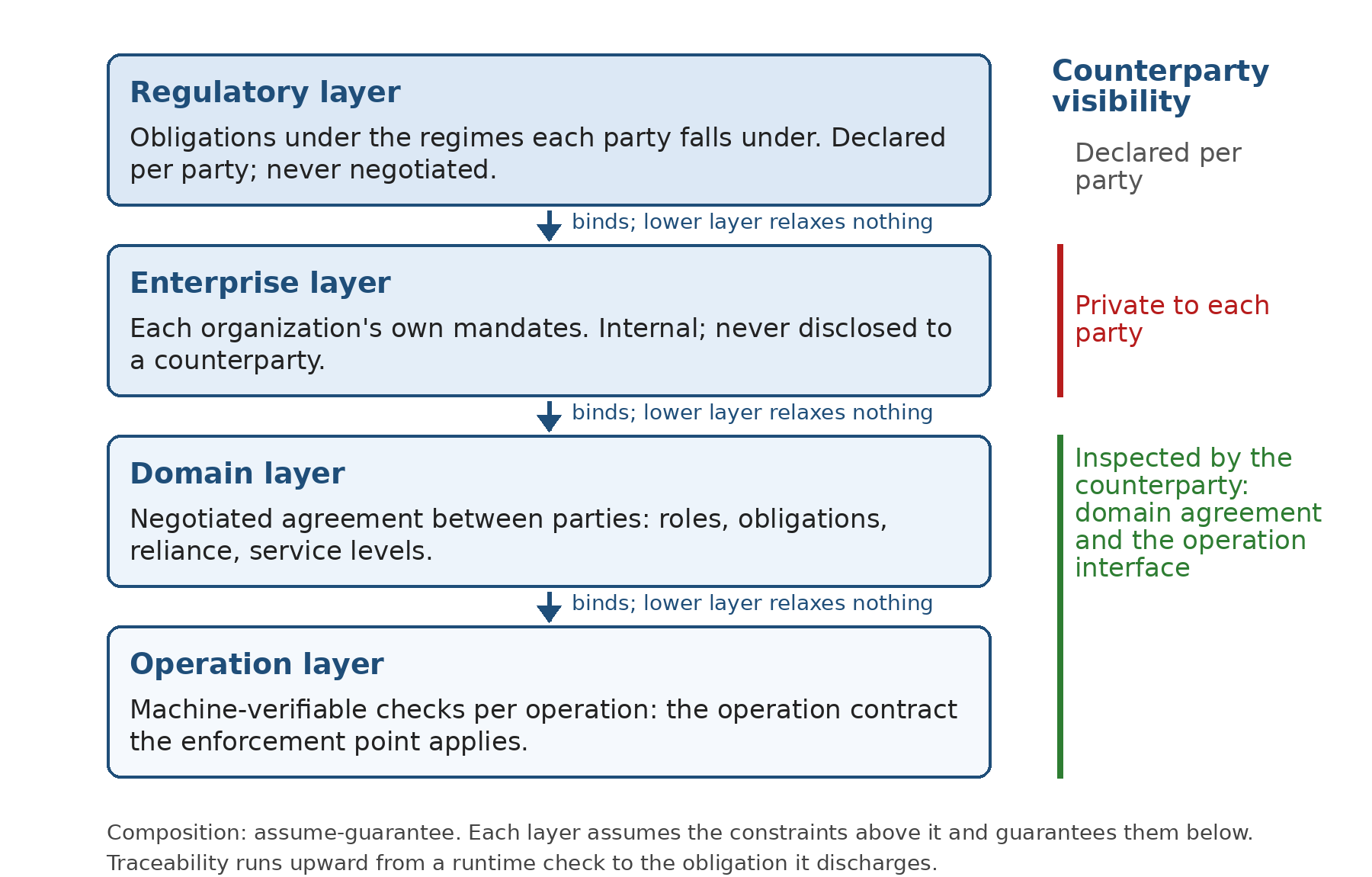
The four-layer contract architecture. Each layer binds the one below it. A lower layer satisfies the constraints of the layer above and relaxes none. A counterparty inspects the domain and operation layers and needs nothing from the other party's enterprise layer.
The layers
- Regulatory layer
Each party records and references the obligations that apply to it under the regimes whose jurisdiction it falls under, for example the EU AI Act or the GDPR for a party operating within their reach. These obligations admit no negotiation. The layer is prose. A legal person is accountable for its reading. Where two parties operate under different regimes, each party's regulatory layer constrains its own side of the domain layer between them.
- Enterprise layer
Each organization's own mandates for its involvement in agentic AI development and deployment, stated once for the organization and applying to every business function. The enterprise layer is internal and is never disclosed to a counterparty.
- Domain layer
The negotiated agreement between organizations for a value stream or business domain: roles, responsibilities, what each party may rely on from the other, and measurable service levels. For example, an EU AI Act Article 25 written agreement belongs at this layer. Recognition between parties under different regimes is expressed at this layer, as terms both accept. The agreement is written for people. The parts the operation layer depends on (the identifier of the agreement, the obligation each operation implements, the service levels it must meet) are stated in a form the operation contracts can reference and the coherence check can test.
- Operation layer
The machine-verifiable checks that implement the domain-layer agreement at runtime, using the Design by Contract constructs of preconditions, postconditions and invariants [Meyer1992]_ adapted to operations carried out by agents. This is the object FG-TIDA WG2 carries as the operation contract in force (FG-TIDA/themes#60, part B): what the agent may commit to without independent verification, the checks before and after commitment, which party performs each, and the disposition when an input is absent, stale or outside its declared bound.
Composition rule
The layers compose by an assume-guarantee scheme. A higher layer assumes that the layers below it uphold its constraints. Each lower layer guarantees that it does. A lower layer may add constraints of its own. It may never relax one from above. Three properties follow.
- Traceability
An auditor can follow a runtime check at the operation layer to the domain term it implements, to the enterprise mandate that term satisfies, and to the regulatory obligation the mandate addresses. Where the obligation has a semantic residual, the trace ends at the residual's declaration and owner. The trace is also how an artifact references the policy it was issued under. The reference names the agreement. It stays stable when any one layer beneath it is reissued.
- Confidentiality by construction
A lower layer never relaxes an upper one. A counterparty therefore learns everything it may rely on from the domain agreement and from the operation-layer interface beneath it. The other party's enterprise layer stays private. The same holds across jurisdictions. Each party's regulatory layer binds its own side of the domain agreement. Both parties inspect the agreement and nothing above it.
- Independent evolution
A party may change its enterprise layer at will, provided its domain agreements still hold. A change that would relax a domain term requires renegotiation. A change that tightens an internal mandate requires none.
Coherence at layer boundaries
Two coherence conditions hold the architecture together. Both are checked before deployment and again when any layer changes.
- Within a layer
The contracts at one layer contain no contradiction with each other. At the operation layer this is the pre-deployment coherence check of the containment architecture [ElBendary2026a]_. The contract set is checked as a whole for contradictions and coverage gaps. A legal person approves it before production.
- Across layers
No contract at a lower layer relaxes a constraint at the layer above. When an upper layer changes, every contract beneath it is re-checked. A contract that no longer satisfies its upper layer is incoherent. No further acts proceed under it until the check passes again. A change at the regulatory or domain layer therefore reaches the point of action through the operation contract's own lifecycle. That is the mechanism by which a withdrawn basis or an amended obligation takes effect.
The second condition is what distinguishes this architecture from a static policy document. The connection decision studied under FG-TIDA/themes#29 gains its change behaviour from it. A basis that is signed, unexpired and in scope at the operation layer, and withdrawn at the domain layer, is caught at the next coherence check.
What crosses an organizational boundary
The architecture draws the boundary between organizations at the domain layer. What crosses it is what the counterparty must depend on to make its own decisions, and no more. From the domain layer: the terms the counterparty relies on. From the operation layer: for each operation the counterparty interacts with, the interface the contract exposes (the operation's identifier, version and hash; the preconditions the counterparty must satisfy or may rely on; the dispositions it will see) and the decision outcome the counterparty is entitled to. The contract's internal conditions and the decision record's internal content stay with the producing party, except where a domain term or a record-side requirement under FG-TIDA/themes#1 calls for them. Nothing from the enterprise layer crosses. Nothing from one party's regulatory layer crosses except as reflected in the domain agreement both accepted.
This matches the line FG-TIDA has drawn elsewhere. The conferral record (FG-TIDA/themes#5) is a domain-layer object. The decision record (FG-TIDA/themes#60, part C) is an operation-layer object. A finding received under FG-TIDA/themes#13 is an input whose standing is given by domain-layer terms, and it confers no authority of its own.
Relation to the containment architecture
The operation layer is where this contribution meets the agentic AI containment architecture [ElBendary2026a]_, from which the least-agency requirements the author contributed on FG-TIDA/themes#4 derive. That architecture binds every operation contract to a verifier, separates actor and verifier roles, binds each execution to the value stream and instance it serves, resets agent state between instances, admits knowledge to persistent memory only after verification, and requires deterministic verifiers for structural properties. The four-layer architecture supplies the three layers above it: where the contract's conditions come from, who agreed to them, and what must be re-checked when they change. The two are designed to be used together. The Propose-Verify-Act-Verify execution model is the runtime form of the operation layer.
Principle
Contracts are formulated from the semantics of the operations they govern. An operation in a business process (reviewing a resume, approving a loan, releasing a shipment) exists independently of the technology that performs it. Its normative definition lives in standard operating procedures, in process documentation and in the tacit knowledge of the people who perform it today. That knowledge is the source of the contractual obligations.
The work this requires is less than it appears. Identifying operation boundaries, inputs and outputs, preconditions, postconditions, and success and failure conditions is standard systems analysis, performed to some degree of formality in any well-engineered system; domain modelling [Evans2003]_ supplies the entities, attributes and behaviours the contracts refer to. The process below organizes that existing work under the four-layer architecture so that it yields operation contracts without a separate modelling effort. It also forces an early question. Is an AI solution needed for the operation at all, given the cost and the risk exposure it adds?
Steps
Identify the use case. Select a business process suitable for AI augmentation, with clear boundaries, identifiable stakeholders across the participating organizations, and operational significance.
State the objectives and the drivers. Express the objectives the parties share for the use case, run the driver analysis of chapter-drivers, and record for each retained driver its owner and its risk synopsis. This step populates the domain layer with the obligations the operation contracts will have to discharge, and surfaces the regulatory and enterprise constraints that bind them.
Assess data maturity and observability. Establish whether every input and state variable an operation will need is available, captured reliably, and observable at execution time. Where gaps exist, language models grounded in the organization's own documentation may extract process activities into an Entry-Task-Validate-Exit form for human validation.
Express the use case semi-formally. Write it as a fully dressed, sea-level use case [Cockburn2001]_: actors and goals, main success path, alternate flows, failure paths, and escalation conditions, so that every execution scenario the contracts must cover is explicit. The same form expresses aligned behaviour whether the interaction is human to agent or agent to agent.
Identify the intelligent behaviours. Within the use case, name the decision-making or interpretive responsibilities an agent will carry out, distinguishing them from mechanical steps.
Decompose into operations. Break each intelligent behaviour into atomic operations with distinct responsibilities, boundaries that can be verified independently, and inputs drawn from observable state.
Define the operation contract. For each operation, specify required and optional inputs, preconditions, postconditions, invariants, failure end conditions, and the special conditions for termination, escalation, rollback and human engagement. Where permitted conduct differs between value streams, model separate operations with separate contracts.
Separate structural and semantic predicates. Classify each condition as structural, enforced by a deterministic verifier, or semantic, delegated to a separately governed inference layer with its own assurance requirements. Conditions that require interpretation of content are semantic; everything decidable over observable inputs is structural.
Validate completeness and coherence. Confirm that every path in the use case is covered by a contract, that no contracts conflict, that every predicate is grounded in the domain model and in observable state, and that no contract relaxes a constraint from the layers above. Compile each contract into machine-readable form (JSON is one example) and obtain the approval of the legal person responsible for its deployment.
Where generative AI assists, and where it does not decide
Steps 3 to 7 can be AI-assisted. A grounded domain ontology and the use-case form make language models serviceable as a compilation layer from the organization's prose (policies, procedures, training manuals) to draft contracts. Correctness is never derived from the model's output. It is established by the deterministic validation in step 9 and by the human approval that precedes deployment. The contract verification path keeps its integrity whatever produced the draft.
Outputs
The process yields, per use case: the retained drivers with owners; the domain-layer agreement terms that discharge them; the set of operation contracts under that agreement, each bound to the value stream it serves and to its verifier; and the record of the coherence check and approval. A receiving organization inspects the domain terms and the operation-layer interface. The enforcement point reads the contract in force at decision time.
Mapping to the record
FG-TIDA item |
Layer |
How the item relates to the layer |
|---|---|---|
Conferral record (themes#5) |
Domain |
The grant, its bounds and who conferred it are domain-layer terms between the conferring and receiving parties. The regulatory and enterprise layers above state what the grant may not relax. |
Operation contract in force (themes#60, part B; WG2 D2) |
Operation |
Identical object. This contribution supplies its lineage: the domain term each condition implements, and the re-check when the upper layer changes. |
Decision record (themes#60, part C; themes#1) |
Operation |
Produced under the operation contract. Crosses the boundary only as the domain terms require. Its content is WG2's. Its record-side properties are themes#1's. |
Basis for a connection (themes#29) |
Domain |
The domain-layer agreement is the basis. The cross-layer coherence condition is its change behaviour. |
What a policy must contain; regime mapping (themes#41) |
Regulatory, domain |
The regulatory layer declares the regime per party; the domain layer is where policies issued under different regimes are reconciled as terms both parties accept. |
Findings and amendments across organizations (themes#13) |
Domain |
Received under terms the domain agreement states. Confer no authority. May bear on a declared precondition and so trigger re-evaluation at the operation layer. |
Reach of a decided change (themes#61, Workstream E) |
Domain, operation |
What the parties agreed to honour as a change is a domain-layer term. Its effect at the point of action is the operation contract's coherence lifecycle. |
Cross-border recognition (themes#62, deliverable 3) |
Regulatory, domain |
The evidence a discovery record points to is issued under a domain agreement between parties whose regulatory layers differ. Recognition requirements are requirements on that agreement. |
Layered security stack (WG2 issue #5 on the charter repository) |
All |
The four contract layers are orthogonal to the four enforcement layers (identity, resource access, role-structural, semantic). The contract layers say where an obligation is authored. The enforcement layers say which control applies it. |
Open questions
The author states these as open, and invites the incubation committee and any interested group to take them up.
- Machine-readable form of regulatory obligations
The architecture's position is stated in chapter-scope. What remains open is per regime: which obligations admit structural predicates at all, and how the semantic residual is kept bounded as regimes change. The SG17 Chair's statement on FG-TIDA/themes#41 identifies the same question. A.3.3 of the terms of reference is its natural home.
- Identifier of the domain-layer agreement
The operation contract is identified by version and content hash (LA-2.3, LA-2.5, LA-2.6 on FG-TIDA/themes#4). The process is identified by its value stream. Neither identifies the agreement between two organizations under which a process runs. One agreement can govern several processes. One process can run under several agreements over time. The traceability argument requires an identifier for the agreement, stable across reissuance of the contracts beneath it. No FG-TIDA text supplies it. Its form is unspecified here.
- Coherence checking across layers
Coherence within the operation layer is required by LA-2.7 and its 4 November append. The containment architecture names cross-layer coherence among the properties a deterministic verifier establishes. No text states how coherence between a domain term and the contracts beneath it is checked, nor what happens when two parties' regulatory layers impose incompatible constraints on one domain agreement. Both are open.
- Driver set validation
The 22 drivers are a starter set derived from the six dimensions and the author's enterprise experience. Validation against submitted FG-TIDA use cases, in particular the multi-party cases under WG0, would confirm or revise the set.
- Residual semantic risk
The architecture bounds semantic risk to a separately governed inference layer and makes the residual explicit. Reducing it is the inference layer's work, outside the contract architecture's guarantees.
Proposed next steps
Dispatch by the incubation committee to the group or queue it judges appropriate, with this document as the input.
Validation of the driver starter set against two or three multi-party use cases from the WG0 repository, with the resulting domain-layer terms and operation contracts published as a worked example.
Alignment of the operation layer's description with the final form of the "operation contract in force" row on FG-TIDA/themes#60, so that the two texts use one vocabulary.
A short study, under A.3.3 or wherever the Focus Group places it, of the regulatory layer in machine-readable form.
Alberts, C.; Dorofee, A. A Framework for Categorizing Key Drivers of Risk. Technical Report CMU/SEI-2009-TR-007. Software Engineering Institute, Carnegie Mellon University, Pittsburgh, PA, 2009.
Cockburn, A. Writing Effective Use Cases. Addison-Wesley, Boston, 2001.
ElBendary, M. Agentic AI Containment Architecture for Security Hardening. In: Arai, K., Lorenz, P. (eds.) Intelligent Systems and Applications. IntelliSys 2026, Volume 3. Lecture Notes in Networks and Systems. Springer Nature Switzerland, 2027. https://doi.org/10.1007/978-3-032-32729-1_21. Preprint: https://doi.org/10.48550/arXiv.2608.26108
ElBendary, M. Bridging the Multi-Organizational AI Governance Gap: A Systemic Risk Modeling Framework for Operationalizing Compliance and Coordination. AAAI 2026 Workshop on AI Governance, Singapore, 2026. https://doi.org/10.5281/zenodo.17781247
Evans, E. Domain-Driven Design: Tackling Complexity in the Heart of Software. Addison-Wesley, Boston, 2003.
Meyer, B. Applying "Design by Contract". IEEE Computer 25(10), pp. 40 to 51, 1992.
FG-TIDA documents referenced
FG-TIDA Terms of Reference, clauses 3, 4 and Annex A (A.2.1, A.2.5, A.3.3).
FG-TIDA WG2 charter, Identity, Behaviour and Enforcement for AI Agents, v0.4, 3 November 2026 (fg-tida-wg2/wg2-ibea-charter).
FG-TIDA/themes#60, Inputs the enforcement point reads at decision time, by object, v3, 16 November 2026.
FG-TIDA/themes#61, Agentic AI trust control plane, draft charter.
FG-TIDA/themes#4, #5, #13, #29, #41, #62 as cited in the text.
The starter set comprises 22 drivers in five categories. The properties column names the objectives a driver typically supports; ownership is allocated per initiative during the analysis of chapter-drivers, and the worked driver in that chapter shows the form an allocation takes. Where a single organization controls the initiative, the cross-organizational coordination category may be omitted.
Category |
Driver |
Definition and properties supported |
|---|---|---|
Data ecosystem |
Training data quality and representativeness |
How well training data mirrors the deployment context and populations. Accuracy, fairness. |
Data ecosystem |
Data provenance and lineage |
Traceability of sources, transformations and rights across the data supply chain. Transparency, auditability. |
Data ecosystem |
Deployment data alignment |
Congruence between training and operational data distributions. Reliability, safety. |
Data ecosystem |
Cross-boundary data governance |
Enforcement of data policies, access control and privacy safeguards collaboratively among all parties. Privacy, accountability. |
Data ecosystem |
Training data sufficiency |
Adequacy of dataset volume and diversity for complete and reliable model behaviour. Reliability. |
Model capability and behaviour |
Architecture appropriateness |
Fit of the model design to the task, operational constraints and risk exposure. Performance, efficiency. |
Model capability and behaviour |
Uncertainty quantification |
How well the model expresses confidence and identifies out-of-distribution scenarios. Safety, reliability. |
Model capability and behaviour |
Emergent capability management |
Controls to detect and mitigate unintended or novel behaviours in large models. Safety. |
Model capability and behaviour |
Interpretability and explainability |
Decisions understandable, auditable and transparent across stakeholders. Transparency, accountability. |
Model capability and behaviour |
Adversarial robustness |
Resilience against malicious perturbation and prompt injection. Security, reliability. |
Human-AI interaction |
Human oversight effectiveness |
Ability of people to monitor, comprehend and intervene, including intervention, refusal and kill-switch pathways. Safety, accountability. |
Human-AI interaction |
User interface and experience design |
How the system communicates purpose, boundaries and functions. Trust, effectiveness. |
Human-AI interaction |
AI literacy and training |
Personnel understanding of capabilities, limitations and risks across the organizations. Appropriate and safe use. |
Human-AI interaction |
Feedback and improvement mechanisms |
Channels returning user and system insight into enhancement cycles. Continuous correction. |
Cross-organizational coordination |
Objective alignment |
Shared understanding of goals and commitments among providers, fine-tuners, deployers and regulators. Coherence of the initiative. |
Cross-organizational coordination |
Information sharing |
Bidirectional exchange of technical, operational and risk intelligence. Coordination, risk mitigation. |
Cross-organizational coordination |
Contractual clarity |
Formal delineation of responsibilities and liabilities across the chain. Accountability. |
Cross-organizational coordination |
Incident response coordination |
Joint procedures for identifying, investigating and resolving cross-boundary failures and breaches. Resilience. |
Regulatory and operational compliance |
Regulatory monitoring |
Continuous tracking of and response to jurisdiction-specific requirements as they evolve. Compliance. |
Regulatory and operational compliance |
Documentation and audit |
Accuracy, completeness and accessibility of system records to auditors and regulators. Transparency, accountability. |
Regulatory and operational compliance |
Conformity assessment |
Readiness for formal evaluations of compliance with legal or market-entry standards. Compliance. |
Regulatory and operational compliance |
Change management and versioning |
Regulatory integrity maintained across system updates. Compliance, stability. |